
How to Rank on Google in Saudi Arabia in 2026: SEO, GEO and AEO for B2B Companies
Ranking on Google in Saudi Arabia in 2026 is fundamentally different from what it was two or three years ago. The goal is no longer simply to appear in a list of ten blue links. AI Overviews now appear on over 25% of queries, and B2B buyers in Riyadh, Jeddah, and Dammam increasingly get their answers directly from AI-generated summaries before ever clicking a link. For your business to be visible, your website needs to work for both traditional search and AI-generated answers simultaneously.
This guide explains the three disciplines that determine search visibility in 2026 — SEO, GEO, and AEO — and how to apply them specifically to the Saudi B2B market.
The Three Layers of Search Visibility in 2026
SEO, AEO, and GEO together represent the three ways your potential clients discover businesses like yours today. The companies that integrate all three into a single content strategy will build a compounding visibility advantage that grows stronger every year.
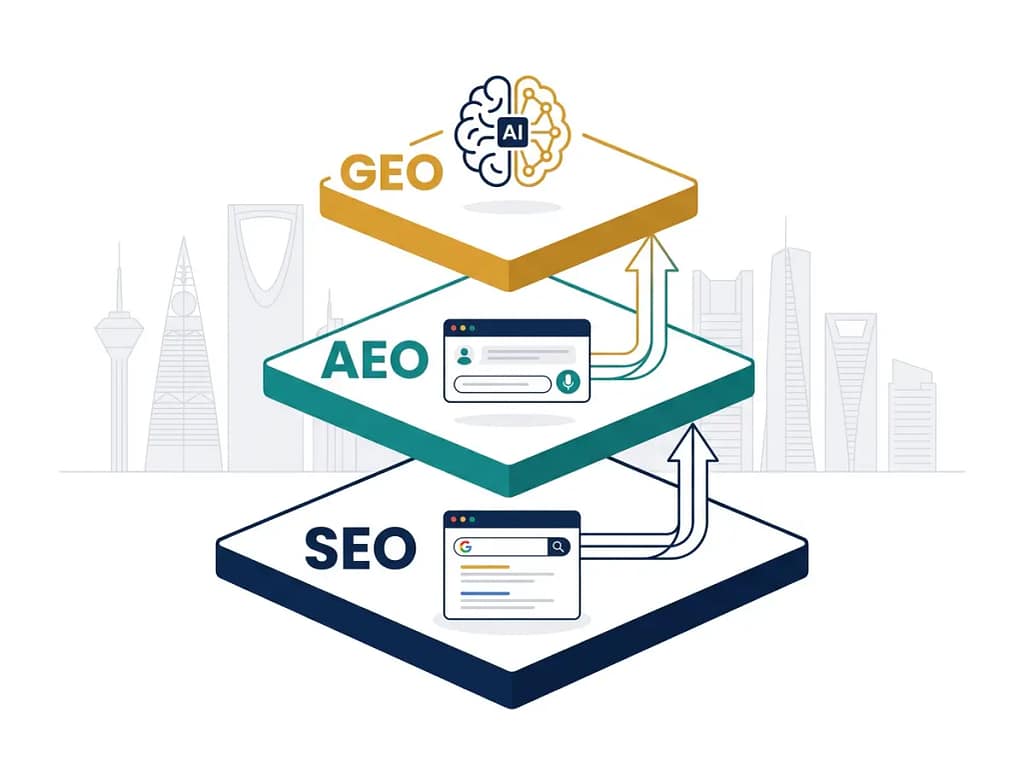
SEO — Traditional Search Rankings
Even in 2026, the fundamentals of SEO still determine whether your website appears on the first page of Google. Technical performance, content quality, backlinks, and local relevance signals all still matter.
For Saudi Arabia specifically, SEO fundamentals include fast mobile loading, clean site architecture, bilingual content in English and Arabic, and city-specific signals for your target markets. SEO is your foundation — without it, neither GEO nor AEO can function.
AEO — Answer Engine Optimisation
AEO is the practice of structuring your content to be selected as the direct answer by AI assistants, voice platforms, and Google’s featured snippet system. Where SEO gets you onto the results page, AEO gets you into the answer box at the top — or spoken directly by a voice assistant.
For B2B companies in Saudi Arabia, this means structuring every page and post around the exact questions your target clients are typing into Google, and answering those questions directly and concisely at the very top of your content.
GEO — Generative Engine Optimisation
GEO is the process of structuring, writing, and publishing content so that AI systems — ChatGPT, Perplexity, Google Gemini, Google AI Overviews, and others — cite your business when answering user queries.
When a procurement manager in Riyadh asks an AI tool “which digital marketing agencies work with B2B companies in Saudi Arabia,” GEO determines whether your name appears in that answer. GEO is not a replacement for SEO — it is an additional layer built on top of a strong SEO foundation.
What Actually Determines Rankings in 2026
Entity Clarity — Google Needs to Know Who You Are
Google in 2026 focuses on entities — brands, people, locations, and services — not just keywords.
Your brand name, your services, your geographic focus, and your expertise need to be described consistently across your website, your schema markup, and every external mention of your business online.
Inconsistency in how you describe yourself confuses Google’s entity graph and reduces your visibility in both traditional and AI search results.
Content That Answers Completely
To appear in AI-generated answers, your content must deliver a complete, self-contained response that fully resolves the user’s question in one visit. A focused 600-word page that completely answers one specific question now outperforms a generic 2,000-word page that covers a topic superficially.
For Saudi B2B content, this means writing pages that genuinely answer questions like “how do I generate B2B leads in Riyadh” — not inserting a city name into a generic marketing article.
Statistical Density and Original Data
AI systems actively prioritise content that backs claims with specific data points over content that makes vague generalisations. If you can publish original observations about the Saudi digital marketing landscape — even a small analysis or a market-specific insight from your direct experience — AI systems will prefer to cite you over competitors who only repeat widely available information. One original data point is worth more than ten generic statements.
Structured Data and Schema Markup
Schema markup is no longer just a technical SEO tool — it is the language AI systems use to understand your business, your services, and your geographic focus.
For a B2B agency serving Saudi Arabia, correctly configured LocalBusiness, Service, and Person schema directly increases the probability of appearing in AI-generated answers about Gulf market digital marketing. Without schema, AI systems have to guess what your business does and where it operates.
Content Freshness
AI retrieval systems actively weight recent content for fast-moving topics. Adding a visible “Last updated” date, including current year statistics, and publishing a “What changed in 2026” section in key articles signals freshness to both Google and AI systems. Stale content — especially content with outdated statistics or references to previous years — is progressively deprioritised in AI-generated answers.
Applying This to the Saudi B2B Market
Arabic Content Is a Competitive Advantage
A significant share of business searches in Saudi Arabia happen in Arabic. Companies operating with English-only websites are structurally invisible to that search volume. Bilingual content — English for international and expat decision-makers, Arabic for local Saudi businesses — doubles your surface area in both traditional search and AI-generated answers.
In a market where most foreign agencies publish only in English, Arabic content is one of the fastest ways to differentiate your visibility.
City-Specific Content Outperforms Generic Gulf Content
A page targeting “digital marketing for SMEs in Riyadh” will rank and get cited significantly more easily than a generic “digital marketing in Saudi Arabia” page. AI systems favour specificity because it signals genuine market knowledge rather than surface-level coverage.
Dedicated content for Riyadh, Jeddah, and Dammam — content that addresses the actual business environment of each city — creates geographic relevance signals that a generic homepage cannot replicate.
Personal Authority Matters as Much as Domain Authority
GEO requires that your name, your expertise, and your brand be consistently associated with your field across the web — not just on your own website. For a boutique agency, this means building a visible personal brand as a Gulf market digital marketing specialist through published content, external mentions, podcast appearances, and consistent positioning across all digital touchpoints.
The more your name appears alongside Gulf market digital marketing in credible external sources, the more AI systems associate you with that topic.
The 2026 Visibility Checklist for Saudi B2B Websites
Technical Foundation
Fast mobile loading, clean site architecture, XML sitemap submitted to Google Search Console, Core Web Vitals passing, no crawl errors.
Entity and Schema Setup
Organisation, LocalBusiness, Person, and Service schema correctly configured, consistent with how you describe your business across all online platforms.
Bilingual Content
Key service pages and homepage available in both English and Arabic at minimum.
Answer-Structured Content
Every major page opens with a direct answer to the question it targets. No building up slowly to the point — lead with the answer, then expand.
City-Specific Pages
Dedicated content for Riyadh, Jeddah, and Dammam that addresses the specific business context of each city, not just a city name inserted into a generic page.
Original Data or Perspective
At least one piece of content per quarter containing something AI systems cannot find elsewhere — a market observation, a data point, or a Gulf-specific insight from direct experience.
Regular Updates
Visible “Last updated” dates on key posts, statistics refreshed annually, and a current-year section added to evergreen articles.
Where to Start
The correct sequence is: fix your technical foundation first, configure your entity schema second, then invest in content. Without the technical foundation, content investment is partially wasted. Without schema, AI systems struggle to correctly understand and cite your business even when your content is excellent.
At Marketing Di Rete, we work with B2B companies and SMEs targeting Saudi Arabia and the Gulf to build exactly this kind of layered visibility — combining Technical SEO, schema implementation, and content strategy into a system that works for both Google rankings and the AI tools your future clients are already using.
If you want to know exactly where your site stands across all three layers, book a free strategy call — we will give you a clear picture of your current position and a concrete path toward visibility in both search and AI-generated answers.