
Communication, Advertising and Marketing — What Is the Difference and Why It Matters for B2B Companies
Last updated: March 2026
Communication, advertising and marketing are three of the most used — and most confused — terms in business. Decision-makers in Saudi Arabia and the Gulf use them interchangeably every day, and that confusion leads to real commercial consequences: misaligned briefs, wasted budget, and strategies that target the wrong layer of the problem.
This post explains exactly what each term means, how they relate to each other, and why the distinction matters practically for B2B companies operating in the Gulf market in 2026.
What Is Marketing? Four Definitions That Actually Explain It
There is no single universally accepted definition of marketing — and that is itself a clue to how broad and misunderstood it is. Here are four definitions that together give you the clearest possible picture.
The American Marketing Association Definition
The American Marketing Association defines marketing as the activity of creating, communicating, delivering, and exchanging offers that have value for customers, partners, and society.
What makes this definition useful is that it brings together four distinct activities — creation, communication, delivery, and exchange — and anchors all of them in the concept of value. Marketing is not just about selling. It is about creating something worth selling, communicating it effectively, delivering it, and exchanging it in a way that generates value for everyone involved — including the broader ecosystem of partners and society.
The Investopedia Definition
Investopedia defines marketing as the discipline that involves all the actions a company takes to acquire customers and maintain relationships with them.
This definition is valuable because it introduces the relationship dimension. Marketing is not a one-time transaction — it is the ongoing process of both acquiring clients and maintaining the relationships that keep them. For B2B companies in Saudi Arabia, where long-term relationship trust is the foundation of commercial success, this dimension of marketing is not optional — it is central.
Sergio Ziman's Definition
Sergio Ziman, former Chief Marketing Officer of Coca-Cola, defines marketing as selling more stuff to more people, more often, for more money, in a more efficient way.
Five factors: quantity, audience breadth, frequency, price, and efficiency. This definition cuts through the academic language and connects marketing directly to commercial outcomes. It is the definition most useful for founders and marketing managers who need to justify budget decisions against measurable results.
Philip Kotler's Definition
Philip Kotler, the father of modern marketing, describes it as the science and art of understanding, creating, and offering value to satisfy customers’ needs and make a profit.
Kotler places value at the centre but adds two critical dimensions that the other definitions leave implicit: the scientific rigour of understanding needs, and the commercial necessity of profitability. Marketing without profit is philanthropy. Understanding without action is research. Kotler’s definition holds both in tension.
A Working Definition for Gulf Market B2B Companies
Synthesising these four perspectives, a working definition for B2B companies in Saudi Arabia and the UAE is this: marketing is the process of finding the right match between what your company offers and what your target clients in the Gulf market actually need — and doing that matching efficiently, consistently, and profitably.
Everything else — communication, advertising, content, SEO, paid campaigns — is a tool in service of that matching process.
The Relationship Between Marketing, Communication and Advertising
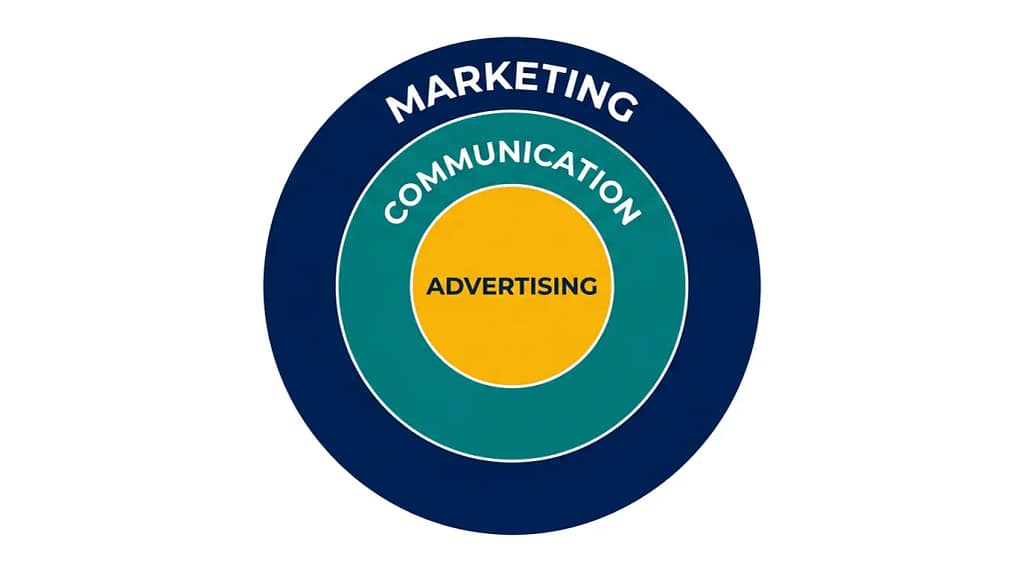
Understanding how these three concepts relate to each other is the key to allocating budget and effort correctly. The clearest way to visualise it is through three concentric circles.
The Outer Circle — Marketing
Marketing is the largest circle. It encompasses everything a company does to match its products and services to the needs of its target clients. It includes product development decisions, pricing strategy, distribution choices, and all forms of communication. In the 4Ps framework — Product, Price, Place, Promotion — marketing is the entire model, not just one part of it.
The 4Ps were developed by Jerome McCarthy in the 1960s and popularised by Kotler. In more modern frameworks they have expanded to 7Ps, adding People, Process, and Physical Evidence — particularly relevant for service businesses like digital marketing agencies operating in the Gulf market. The fundamental structure remains: marketing is the complete system, not a single activity.
The Middle Circle — Communication
Communication sits inside the marketing circle. It corresponds to the fourth P — Promotion — and covers all the ways a company conveys its message to its target audience.
Communication includes public relations, content creation, tone of voice definition, brand messaging, and paid promotion. It also includes how your sales team presents your services, how your proposals are written, and how your website speaks to visitors. For B2B companies in Saudi Arabia, communication includes the critical dimension of Arabic-language content — which is not a translation exercise but a full communication strategy adapted for Gulf market cultural and linguistic context.
What communication does not include is product development, pricing decisions, or distribution strategy. Those belong to other parts of the marketing system.
The Inner Circle — Advertising
Advertising sits inside the communication circle. It is a specific subset of communication — the part that involves paid promotion through third-party channels to carry your message to a target audience.
Advertising includes Google Search Ads, Meta Ads on Facebook and Instagram, LinkedIn Ads, YouTube pre-roll, traditional TV and radio, outdoor billboards, and any other paid placement of your message through a channel you do not own. What defines advertising is three things: it is paid, it uses a third-party channel, and it is targeted at a defined audience.
Advertising is a powerful tool, but it is one piece of a much larger system. Companies that treat advertising as synonymous with marketing tend to overspend on paid channels and underinvest in the foundational marketing work — product positioning, pricing, and strategic communication — that makes advertising work in the first place.
Why This Distinction Matters Practically for B2B Companies in Saudi Arabia
Misidentifying the Problem Leads to Wrong Solutions
When a B2B company in Saudi Arabia says “our marketing is not working,” they are usually pointing to one of three different problems — each requiring a completely different solution.
If the real problem is that their offer does not match what the market needs, that is a marketing problem — specifically a product or positioning problem. Running more advertising will not fix it.
If the real problem is that their message is unclear, inconsistent, or not reaching the right people, that is a communication problem. Better advertising targeting will not fix unclear messaging.
If the real problem is that their advertising campaigns are underperforming, that is an advertising problem — potentially solvable with better creative, better audience targeting, or better campaign structure.
Diagnosing which circle the problem lives in is the prerequisite for solving it efficiently.
Budget Allocation Follows the Diagnosis
For B2B companies in Saudi Arabia with limited marketing budgets, understanding this hierarchy directly affects return on investment. Spending on advertising before the communication layer is clear — before you have a defined message, a credible brand presence, and content that establishes authority — is one of the most common and most expensive mistakes in Gulf market digital marketing.
The investment sequence that consistently delivers the best ROI for B2B companies in Saudi Arabia is: establish your marketing foundation first (positioning, ICP, value proposition), build your communication layer second (website, content, Arabic and English messaging), then activate advertising to amplify what is already working organically.
GEO, SEO and AEO Live at the Communication Layer
In 2026, the communication layer has expanded significantly. Technical SEO, bilingual content strategy, schema markup, and GEO optimisation for AI-generated answers are all communication decisions — they determine how your business is understood and presented by both search engines and AI systems to your target clients.
A B2B company in Saudi Arabia that invests in clear entity definition, authoritative bilingual content, and structured data is building communication infrastructure that makes every other marketing activity more effective — including advertising, which performs measurably better when it points to a well-structured, high-credibility digital presence.
The 4Ps and 7Ps — A Practical Reference for Gulf Market B2B
The Original 4Ps
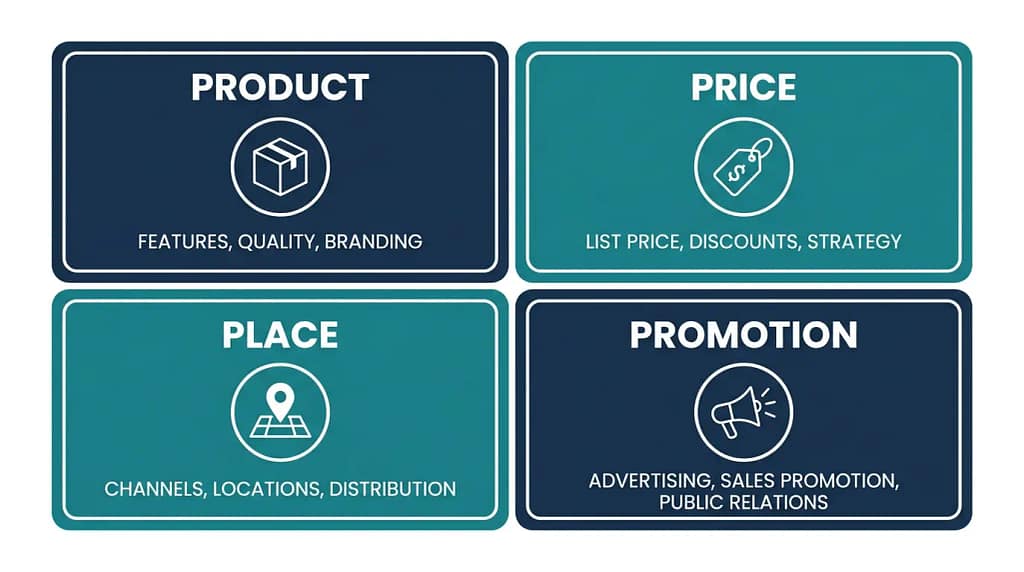
Product — what you are selling and how it is positioned for the Saudi and Gulf market. Price — your pricing strategy and how it reflects perceived value in the Gulf B2B context. Place — how and where your service is delivered and accessed. Promotion — all communication and advertising activities used to reach your target audience.
The Extended 7Ps for Service Businesses
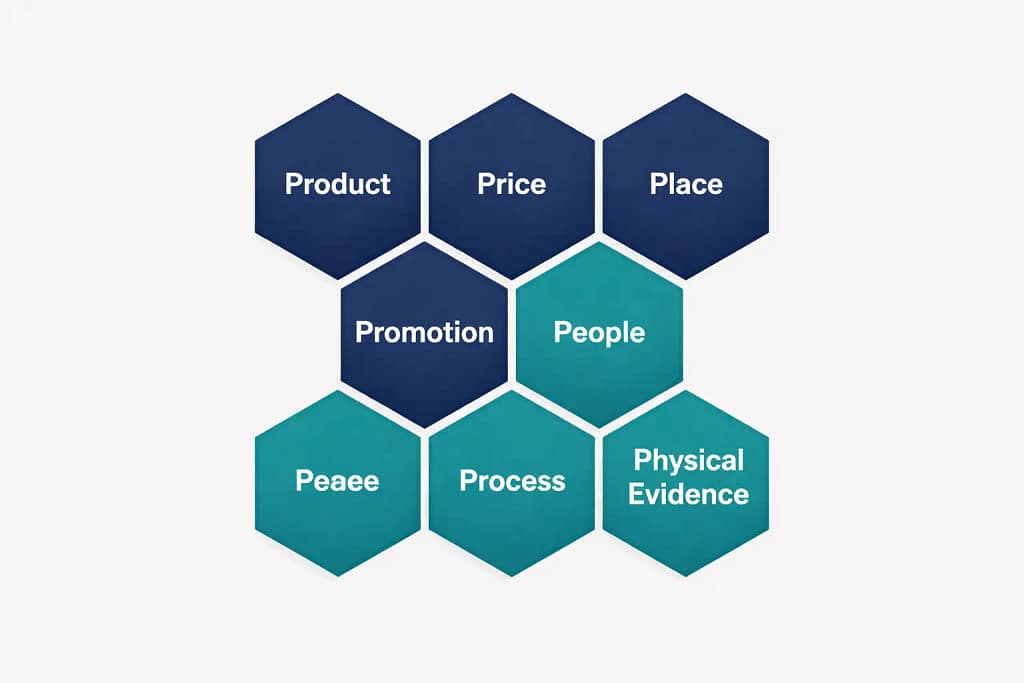
The three additional Ps are particularly relevant for digital marketing agencies and B2B service providers operating in Saudi Arabia. People — the expertise, cultural knowledge, and language capabilities of your team, including Arabic fluency as a differentiator. Process — how your service is delivered, from onboarding to reporting, and how that process builds rather than erodes client trust.
Physical Evidence — the tangible signals of credibility that Gulf market clients look for: case studies, certifications, schema-verified entity data, and a professionally structured website.
Frequently Asked Questions
What is the main difference between marketing, communication and advertising?
Marketing is the complete system — everything a company does to match its offer to client needs profitably. Communication is one part of marketing — how the company conveys its message across all channels. Advertising is one part of communication — specifically the paid, third-party channel placement of that message. Every advertisement is a form of communication, and every form of communication is part of marketing, but the reverse is not true.
Can a B2B company in Saudi Arabia do marketing without advertising?
Yes — and many successful B2B companies in Saudi Arabia do exactly that in their early stages. Organic SEO, content marketing, LinkedIn organic presence, referral networks, and direct outreach are all marketing and communication activities that do not require paid advertising. Advertising accelerates reach but is not the foundation of marketing. The foundation is a clear value proposition, a well-defined ICP, and credible communication that establishes authority before any budget is spent on paid channels.
Why do so many businesses confuse marketing with advertising?
Because advertising is the most visible and measurable part of the marketing system. When you run a Google Ad or a LinkedIn campaign, you see immediate data — impressions, clicks, leads. The deeper work of positioning, messaging, and relationship-building is slower and less immediately quantifiable. This visibility bias causes businesses to overindex on advertising and underinvest in the broader marketing and communication foundation that determines whether advertising works at all.
What does communication include in a marketing context?
In a marketing context, communication includes all forms of message delivery: content marketing, public relations, social media, email, website copy, sales presentations, proposals, tone of voice guidelines, Arabic and English language strategy, and paid advertising. It also includes the technical infrastructure that determines how your message is found — SEO, schema markup, and GEO optimisation for AI-generated answers.
How does the 4Ps framework apply to digital marketing agencies serving Saudi Arabia?
For a digital marketing agency serving B2B clients in Saudi Arabia, the 4Ps translate directly: Product is the specific service packages offered — Technical SEO, paid advertising, web design, social media management — and how they are positioned for Gulf market B2B needs. Price reflects the value delivered in a market where quality and trust carry significant premium. Place is the digital delivery model — remote from the UAE or Italy, serving clients across Saudi Arabia through digital channels. Promotion is the agency’s own marketing — the content, SEO, and advertising that makes it visible to Saudi B2B decision-makers searching for exactly these services.
The Bottom Line
Marketing, communication and advertising are not interchangeable. They are nested layers of a single system — and understanding which layer your problem or opportunity lives in is what separates companies that spend efficiently from those that waste budget on solutions to the wrong problem.
For B2B companies in Saudi Arabia and the Gulf, this clarity is not academic — it is commercially critical. The market is growing fast, competition is intensifying, and the companies that build their marketing system in the right sequence — foundation first, communication second, advertising to amplify — will have a structural advantage over those that skip straight to paid channels.
At Marketing Di Rete, we help B2B companies in Saudi Arabia build exactly this kind of structured, layered digital marketing system — from positioning and Technical SEO through to paid advertising on Google and LinkedIn.
Book a free strategy call to understand where your current marketing, communication and advertising strategy stands and what the most efficient path to Gulf market visibility looks like for your business.