Author: Marketing Di Rete

  • Successful PPC (Pay-Per-Click) Advertising

    Successful PPC (Pay-Per-Click) Advertising

    All You Need to Know About PPC (Pay-Per-Click) Advertising

    Last updated: March 2026

    What is PPC and Why Should You Care?

    PPC, Pay-Per-Click, is a digital advertising model where you pay only when someone clicks on your ad.

    Imagine launching an ad and getting instant visibility for your business. That’s the power of PPC!

     Unlike organic marketing, Pay Per Click offers immediate traffic, measurable results, and precision targeting. But how does it work, and why is it crucial for businesses today? Let’s break it down in a way that’s easy to understand!

    lead generation ppc

    How Does PPC Work?

    PPC works through an auction-based system. Advertisers bid on keywords, and when users search for those terms, the highest quality and most relevant ads appear on search engines or social platforms. Each time someone clicks on your ad, you pay a small fee. Sounds simple, right? Well, there’s more to it!

    Why PPC is a Game-Changer for Businesses

    • Instant Visibility: Unlike SEO, which takes time, Pay Per Click gives your business immediate exposure on search engines and social media.
    • Highly Targeted Advertising: You can filter audiences by location, interests, device, and even search intent.
    • Cost-Effective: You only pay when someone clicks your ad, ensuring budget efficiency.
    • Better Conversion Rates: Pay Per Click ads reach users actively searching for your products or services.
    • Measurable Results: Real-time analytics help you track performance and optimize for better ROI.

    Top PPC Platforms & Where You Should Advertise

    1. Google Ads
    • Best for intent-driven searches
    • Works on Google Search, YouTube, and partner websites
    • Ideal for both small businesses and enterprises
    1. Facebook & Instagram Ads
    • Excellent for visually engaging content
    • Best for brand awareness and lead generation
    • Advanced audience targeting based on demographics & behaviors
    1. LinkedIn Ads
    • Best for B2B lead generation
    • Targets professionals, decision-makers, and industry leaders
    • Effective for high-ticket sales and services
    1. Microsoft (Bing) Ads
    • Less competition, lower cost-per-click (CPC)
    • Ideal for reaching an alternative audience
    • Works well for finance, tech, and professional services

    How to Create a Winning PPC Campaign

    Step 1: Define Your Goals

    Do you want more website traffic, leads, or sales? A clear goal helps shape your Pay Per Click strategy.

    Step 2: Keyword Research

    Use tools like Google Keyword Planner to find high-intent keywords that match what users are searching for.

    Step 3: Craft Compelling Ad Copy

    • Headline: Grab attention with a clear, enticing message.
    • Description: Highlight benefits, include a strong call-to-action (CTA).
    • URL: Use a clean, keyword-rich landing page.

    Step 4: Set a Budget & Bidding Strategy

    Decide how much you’re willing to spend daily and choose between manual or automated bidding.

    Step 5: Optimize Landing Pages

    Your ads are only as good as your landing pages. Ensure fast load times, strong CTAs, and mobile-friendly designs.

    Step 6: Monitor, Test, and Improve

    Track key metrics like CTR (Click-Through Rate), CPC (Cost-Per-Click), and ROAS (Return on Ad Spend). A/B test different elements to find what works best.

    Common PPC Mistakes to Avoid

    🚫 Ignoring Negative Keywords

    – These prevent wasted ad spend on irrelevant searches.

    🚫 Not Optimizing for Mobile

    – Over 60% of users browse on mobile. Make sure your ads and landing pages are mobile-friendly.

    🚫 Skipping A/B Testing

    – Test different ad creatives, headlines, and CTAs to improve conversions.

    🚫 Poor Budget Allocation

    – Distribute your budget wisely across high-performing keywords.

    Is PPC Worth It? Absolutely!

    Pay Per Click advertising is one of the fastest ways to drive traffic, leads, and sales for your business. Whether you’re a startup or an established brand, PPC offers precise targeting, cost control, and data-driven results. If you’re not using Pay Per Click yet, now is the time to start!

    Need expert help? Let’s create a high-converting Pay Per Click strategy tailored to your business goals.

    Future Trends in PPC Advertising

    As digital marketing continues to evolve, Pay Per Click strategies must adapt to stay effective. Here are some emerging trends to watch:

    1. AI & Automation in Pay Per Click

    Artificial Intelligence (AI) and machine learning are revolutionizing Pay Per Click campaigns. Platforms like Google Ads use AI-powered Smart Bidding to optimize ad performance, helping businesses achieve better results with minimal manual intervention.

    1. Voice Search Optimization

    With the rise of smart speakers and voice assistants, more users are conducting searches using natural language. Pay Per Click advertisers should incorporate long-tail and conversational keywords to align with voice search queries.

    1. Video Ads Dominating PPC

    Video content continues to gain traction, with platforms like YouTube, TikTok, and Facebook offering Pay Per Click video ad options. Businesses should invest in engaging video creatives to capture audience attention and drive higher conversions.

    1. Privacy-First Advertising

    With stricter privacy laws and changes like cookie deprecation, advertisers must focus on first-party data collection and ethical ad targeting. Pay Per Click campaigns will need to rely more on audience segmentation and contextual advertising.

    1. Growth of Alternative PPC Platforms

    While Google and Facebook dominate the Pay Per Click landscape, alternative platforms like Amazon Ads, TikTok Ads, and Pinterest Ads are gaining popularity. Businesses should explore diverse ad channels to maximize their reach and effectiveness.

    By staying ahead of these trends, businesses can refine their Pay Per Click strategies and maintain a competitive edge in digital advertising.

  • Difference between Communication Advertising and Marketing

    Difference between Communication Advertising and Marketing

    Communication, Advertising and Marketing — What Is the Difference and Why It Matters for B2B Companies

    Last updated: March 2026

    Communication, advertising and marketing are three of the most used — and most confused — terms in business. Decision-makers in Saudi Arabia and the Gulf use them interchangeably every day, and that confusion leads to real commercial consequences: misaligned briefs, wasted budget, and strategies that target the wrong layer of the problem.


    This post explains exactly what each term means, how they relate to each other, and why the distinction matters practically for B2B companies operating in the Gulf market in 2026.

    What Is Marketing? Four Definitions That Actually Explain It

    There is no single universally accepted definition of marketing — and that is itself a clue to how broad and misunderstood it is. Here are four definitions that together give you the clearest possible picture.

    The American Marketing Association Definition

    The American Marketing Association defines marketing as the activity of creating, communicating, delivering, and exchanging offers that have value for customers, partners, and society.


    What makes this definition useful is that it brings together four distinct activities — creation, communication, delivery, and exchange — and anchors all of them in the concept of value. Marketing is not just about selling. It is about creating something worth selling, communicating it effectively, delivering it, and exchanging it in a way that generates value for everyone involved — including the broader ecosystem of partners and society.

    The Investopedia Definition

    Investopedia defines marketing as the discipline that involves all the actions a company takes to acquire customers and maintain relationships with them.


    This definition is valuable because it introduces the relationship dimension. Marketing is not a one-time transaction — it is the ongoing process of both acquiring clients and maintaining the relationships that keep them. For B2B companies in Saudi Arabia, where long-term relationship trust is the foundation of commercial success, this dimension of marketing is not optional — it is central.

    Sergio Ziman’s Definition

    Sergio Ziman, former Chief Marketing Officer of Coca-Cola, defines marketing as selling more stuff to more people, more often, for more money, in a more efficient way.


    Five factors: quantity, audience breadth, frequency, price, and efficiency. This definition cuts through the academic language and connects marketing directly to commercial outcomes. It is the definition most useful for founders and marketing managers who need to justify budget decisions against measurable results.

    Philip Kotler’s Definition

    Philip Kotler, the father of modern marketing, describes it as the science and art of understanding, creating, and offering value to satisfy customers’ needs and make a profit.


    Kotler places value at the centre but adds two critical dimensions that the other definitions leave implicit: the scientific rigour of understanding needs, and the commercial necessity of profitability. Marketing without profit is philanthropy. Understanding without action is research. Kotler’s definition holds both in tension.

    A Working Definition for Gulf Market B2B Companies

    Synthesising these four perspectives, a working definition for B2B companies in Saudi Arabia and the UAE is this: marketing is the process of finding the right match between what your company offers and what your target clients in the Gulf market actually need — and doing that matching efficiently, consistently, and profitably.


    Everything else — communication, advertising, content, SEO, paid campaigns — is a tool in service of that matching process.

    The Relationship Between Marketing, Communication and Advertising

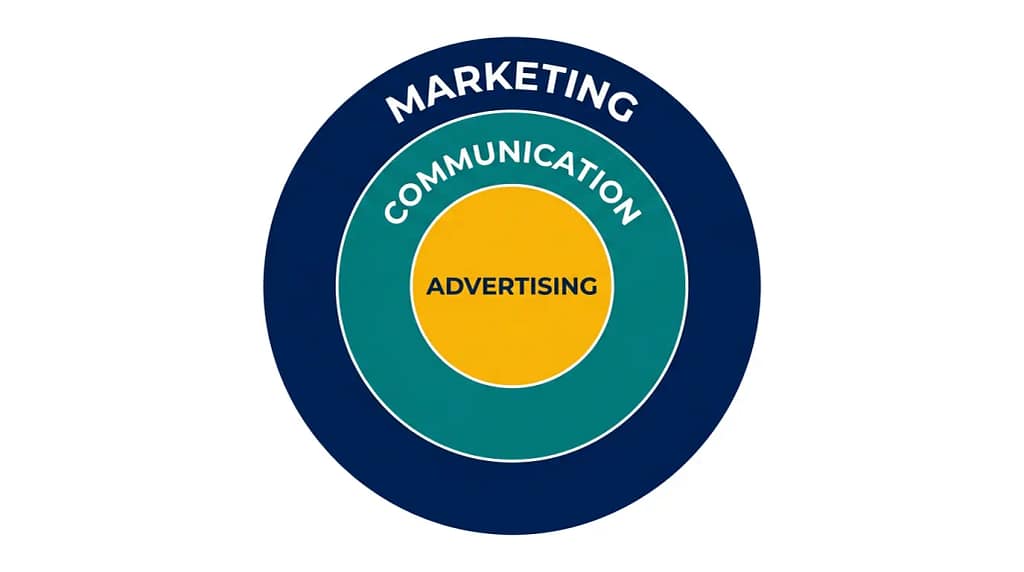
    Understanding how these three concepts relate to each other is the key to allocating budget and effort correctly. The clearest way to visualise it is through three concentric circles.

    difference between communication advertising and marketing three circles B2B 2026

    The Outer Circle — Marketing

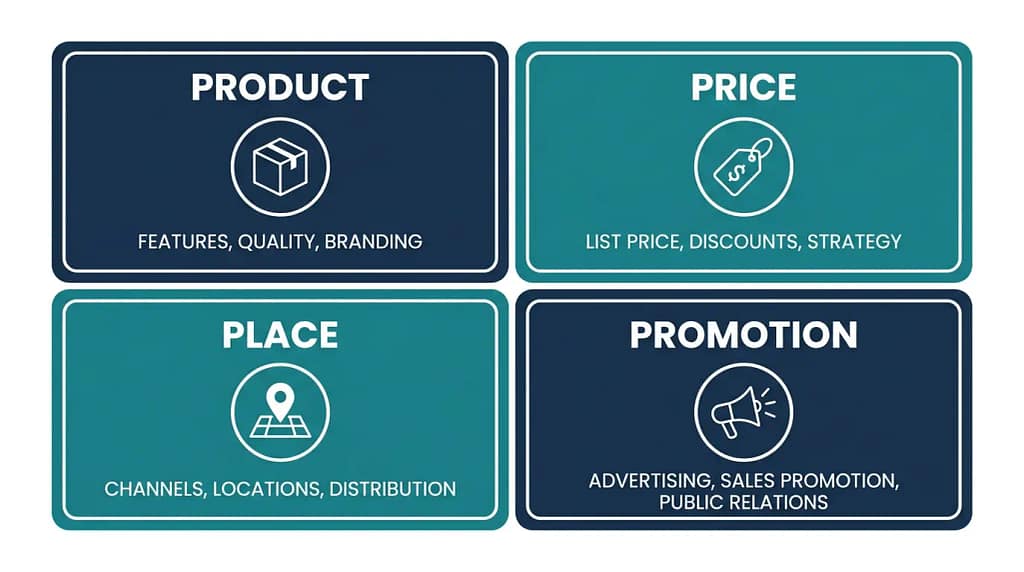
    Marketing is the largest circle. It encompasses everything a company does to match its products and services to the needs of its target clients. It includes product development decisions, pricing strategy, distribution choices, and all forms of communication. In the 4Ps framework — Product, Price, Place, Promotion — marketing is the entire model, not just one part of it.


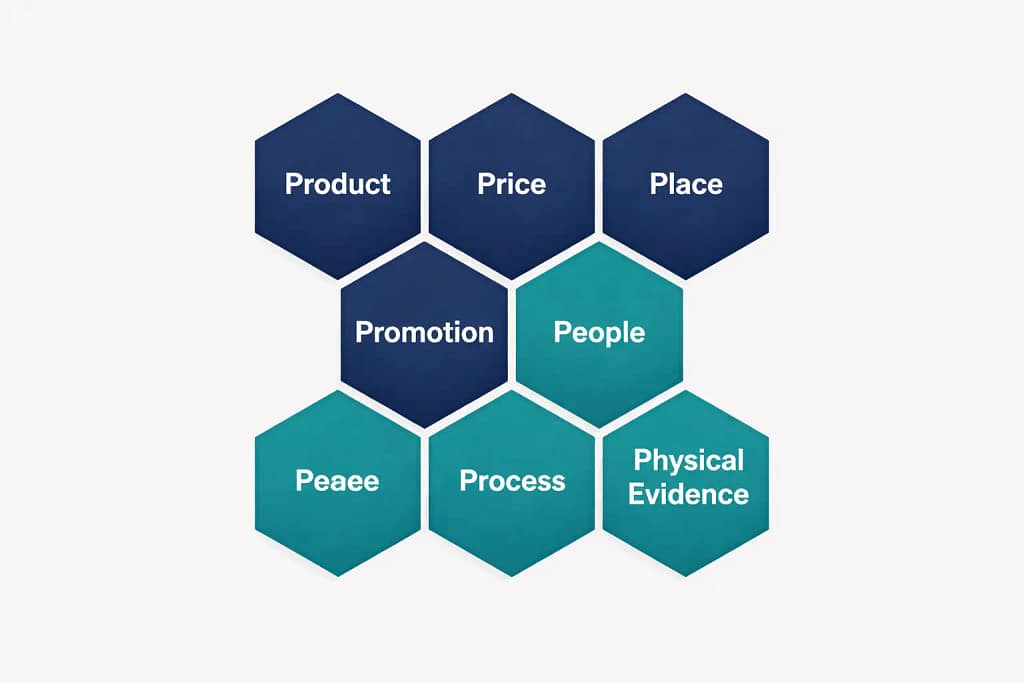
    The 4Ps were developed by Jerome McCarthy in the 1960s and popularised by Kotler. In more modern frameworks they have expanded to 7Ps, adding People, Process, and Physical Evidence — particularly relevant for service businesses like digital marketing agencies operating in the Gulf market. The fundamental structure remains: marketing is the complete system, not a single activity.

    The Middle Circle — Communication

    Communication sits inside the marketing circle. It corresponds to the fourth P — Promotion — and covers all the ways a company conveys its message to its target audience.


    Communication includes public relations, content creation, tone of voice definition, brand messaging, and paid promotion. It also includes how your sales team presents your services, how your proposals are written, and how your website speaks to visitors. For B2B companies in Saudi Arabia, communication includes the critical dimension of Arabic-language content — which is not a translation exercise but a full communication strategy adapted for Gulf market cultural and linguistic context.


    What communication does not include is product development, pricing decisions, or distribution strategy. Those belong to other parts of the marketing system.

    The Inner Circle — Advertising

    Advertising sits inside the communication circle. It is a specific subset of communication — the part that involves paid promotion through third-party channels to carry your message to a target audience.


    Advertising includes Google Search Ads, Meta Ads on Facebook and Instagram, LinkedIn Ads, YouTube pre-roll, traditional TV and radio, outdoor billboards, and any other paid placement of your message through a channel you do not own. What defines advertising is three things: it is paid, it uses a third-party channel, and it is targeted at a defined audience.


    Advertising is a powerful tool, but it is one piece of a much larger system. Companies that treat advertising as synonymous with marketing tend to overspend on paid channels and underinvest in the foundational marketing work — product positioning, pricing, and strategic communication — that makes advertising work in the first place.

    Why This Distinction Matters Practically for B2B Companies in Saudi Arabia

    Misidentifying the Problem Leads to Wrong Solutions

    When a B2B company in Saudi Arabia says “our marketing is not working,” they are usually pointing to one of three different problems — each requiring a completely different solution.


    If the real problem is that their offer does not match what the market needs, that is a marketing problem — specifically a product or positioning problem. Running more advertising will not fix it.


    If the real problem is that their message is unclear, inconsistent, or not reaching the right people, that is a communication problem. Better advertising targeting will not fix unclear messaging.


    If the real problem is that their advertising campaigns are underperforming, that is an advertising problem — potentially solvable with better creative, better audience targeting, or better campaign structure.
    Diagnosing which circle the problem lives in is the prerequisite for solving it efficiently.

    Budget Allocation Follows the Diagnosis

    For B2B companies in Saudi Arabia with limited marketing budgets, understanding this hierarchy directly affects return on investment. Spending on advertising before the communication layer is clear — before you have a defined message, a credible brand presence, and content that establishes authority — is one of the most common and most expensive mistakes in Gulf market digital marketing.


    The investment sequence that consistently delivers the best ROI for B2B companies in Saudi Arabia is: establish your marketing foundation first (positioning, ICP, value proposition), build your communication layer second (website, content, Arabic and English messaging), then activate advertising to amplify what is already working organically.

    GEO, SEO and AEO Live at the Communication Layer

    In 2026, the communication layer has expanded significantly. Technical SEO, bilingual content strategy, schema markup, and GEO optimisation for AI-generated answers are all communication decisions — they determine how your business is understood and presented by both search engines and AI systems to your target clients.


    A B2B company in Saudi Arabia that invests in clear entity definition, authoritative bilingual content, and structured data is building communication infrastructure that makes every other marketing activity more effective — including advertising, which performs measurably better when it points to a well-structured, high-credibility digital presence.

    The 4Ps and 7Ps — A Practical Reference for Gulf Market B2B

    The Original 4Ps

    4Ps of marketing framework Product Price Place Promotion B2B guide

    Product — what you are selling and how it is positioned for the Saudi and Gulf market. Price — your pricing strategy and how it reflects perceived value in the Gulf B2B context. Place — how and where your service is delivered and accessed. Promotion — all communication and advertising activities used to reach your target audience.

    The Extended 7Ps for Service Businesses

    The three additional Ps are particularly relevant for digital marketing agencies and B2B service providers operating in Saudi Arabia. People — the expertise, cultural knowledge, and language capabilities of your team, including Arabic fluency as a differentiator. Process — how your service is delivered, from onboarding to reporting, and how that process builds rather than erodes client trust.

    Physical Evidence — the tangible signals of credibility that Gulf market clients look for: case studies, certifications, schema-verified entity data, and a professionally structured website.

    Frequently Asked Questions

    What is the main difference between marketing, communication and advertising?

    Marketing is the complete system — everything a company does to match its offer to client needs profitably. Communication is one part of marketing — how the company conveys its message across all channels. Advertising is one part of communication — specifically the paid, third-party channel placement of that message. Every advertisement is a form of communication, and every form of communication is part of marketing, but the reverse is not true.

    Can a B2B company in Saudi Arabia do marketing without advertising?

    Yes — and many successful B2B companies in Saudi Arabia do exactly that in their early stages. Organic SEO, content marketing, LinkedIn organic presence, referral networks, and direct outreach are all marketing and communication activities that do not require paid advertising. Advertising accelerates reach but is not the foundation of marketing. The foundation is a clear value proposition, a well-defined ICP, and credible communication that establishes authority before any budget is spent on paid channels.

    Why do so many businesses confuse marketing with advertising?

    Because advertising is the most visible and measurable part of the marketing system. When you run a Google Ad or a LinkedIn campaign, you see immediate data — impressions, clicks, leads. The deeper work of positioning, messaging, and relationship-building is slower and less immediately quantifiable. This visibility bias causes businesses to overindex on advertising and underinvest in the broader marketing and communication foundation that determines whether advertising works at all.

    What does communication include in a marketing context?

    In a marketing context, communication includes all forms of message delivery: content marketing, public relations, social media, email, website copy, sales presentations, proposals, tone of voice guidelines, Arabic and English language strategy, and paid advertising. It also includes the technical infrastructure that determines how your message is found — SEO, schema markup, and GEO optimisation for AI-generated answers.

    How does the 4Ps framework apply to digital marketing agencies serving Saudi Arabia?

    For a digital marketing agency serving B2B clients in Saudi Arabia, the 4Ps translate directly: Product is the specific service packages offered — Technical SEO, paid advertising, web design, social media management — and how they are positioned for Gulf market B2B needs. Price reflects the value delivered in a market where quality and trust carry significant premium. Place is the digital delivery model — remote from the UAE or Italy, serving clients across Saudi Arabia through digital channels. Promotion is the agency’s own marketing — the content, SEO, and advertising that makes it visible to Saudi B2B decision-makers searching for exactly these services.

    The Bottom Line

    Marketing, communication and advertising are not interchangeable. They are nested layers of a single system — and understanding which layer your problem or opportunity lives in is what separates companies that spend efficiently from those that waste budget on solutions to the wrong problem.


    For B2B companies in Saudi Arabia and the Gulf, this clarity is not academic — it is commercially critical. The market is growing fast, competition is intensifying, and the companies that build their marketing system in the right sequence — foundation first, communication second, advertising to amplify — will have a structural advantage over those that skip straight to paid channels.


    At Marketing Di Rete, we help B2B companies in Saudi Arabia build exactly this kind of structured, layered digital marketing system — from positioning and Technical SEO through to paid advertising on Google and LinkedIn.


    Book a free strategy call to understand where your current marketing, communication and advertising strategy stands and what the most efficient path to Gulf market visibility looks like for your business.

  • Social Media Marketing Saudi Arabia — B2B Strategy 2026

    Social Media Marketing Saudi Arabia — B2B Strategy 2026

    Social Media Marketing Saudi Arabia — The B2B Strategy Guide for 2026

    Last updated: March 2026

    Not every B2B company in Saudi Arabia should be on every social media platform. In fact, one of the most expensive mistakes B2B companies make in the Gulf market is spreading their social media presence thin across multiple platforms, producing mediocre content on all of them, and measuring success by follower counts that never convert into clients.

    This guide cuts through the noise. It covers which platforms actually matter for B2B companies in Saudi Arabia in 2026, how to build a social media strategy that generates commercial results rather than vanity metrics, and how to use social media as part of a broader digital visibility system that includes SEO and paid advertising.

    I work with B2B companies and SMEs targeting Saudi Arabia and the Gulf market. What follows reflects what I have observed working directly in this market — not generic social media theory.

    Should Your B2B Company Be on Social Media in Saudi Arabia?

    The Question Most Businesses Skip

    Before deciding which platforms to use, the right question is whether social media is the appropriate channel for your specific B2B offering in the Saudi market at your current stage of growth.

    Social media works exceptionally well for B2B companies in Saudi Arabia when at least one of these conditions is true. Your target clients — procurement managers, CEOs, operations directors — are active on a platform where you can reach them professionally. Your service or product can be demonstrated, explained, or evidenced through content in a way that builds credibility over time. Your sales cycle is long enough that sustained visibility across multiple touchpoints adds genuine commercial value.

    If none of these conditions apply to your business, paid search advertising and SEO will almost always deliver better ROI than social media for B2B in Saudi Arabia. Social media is not a universal requirement — it is one channel among several, and it should earn its place in your budget based on commercial logic, not because everyone else is doing it.

    The Saudi B2B Social Media Landscape in 2026

    Saudi Arabia has one of the highest social media usage rates in the world. However, platform usage patterns for B2B decision-makers in the Kingdom differ significantly from global averages and from consumer behaviour patterns.

    LinkedIn has established itself as the primary professional network for B2B decision-making in Saudi Arabia, particularly in Riyadh and Jeddah where the concentration of corporate and government-adjacent businesses is highest.

    Twitter/X retains significant influence among Saudi business professionals and executives — a characteristic of the Gulf market that differs from most other regions.


    WhatsApp remains the dominant direct communication channel for B2B relationship management in the Kingdom, functioning more like email than social media in a professional context. Instagram and Snapchat are dominant in consumer markets but have limited B2B application for most sectors.

    Which Social Media Platforms Actually Matter for B2B Saudi Arabia

    social media marketing Saudi Arabia B2B strategy guide 2026

    LinkedIn — The Non-Negotiable B2B Platform

    For B2B companies in Saudi Arabia, LinkedIn is the only social media platform that is genuinely non-negotiable. It is where Saudi procurement managers research vendors, where executives validate the credibility of potential partners, and where B2B companies build the professional authority that translates into commercial conversations.

    A credible LinkedIn presence for a B2B company in Saudi Arabia means three things. A complete, professionally written company page that clearly communicates who you serve, what you do, and what results you deliver — in English and increasingly in Arabic. Consistent content publishing — minimum two to three posts per week — that demonstrates genuine expertise in your sector and the Saudi market specifically.

    Active personal presence from the founder or senior team, since B2B buyers in Saudi Arabia buy from people they trust, not from corporate pages they follow.

    LinkedIn’s paid advertising is also the most precise B2B targeting tool available in the Saudi market — allowing you to reach specific job titles, industries, company sizes, and seniority levels with content and lead generation campaigns that would be impossible to execute at equivalent precision through any other channel.

    Twitter/X — Influence and Executive Visibility in the Gulf

    Twitter/X retains a level of influence among Saudi business professionals and government-adjacent executives that is unique to the Gulf market. Saudi Arabia consistently ranks among the highest Twitter usage countries globally, and the platform functions as a real-time professional discourse channel for business and policy topics in the Kingdom.

    For B2B companies in Saudi Arabia, Twitter/X is most valuable for brand visibility and thought leadership rather than direct lead generation. Engaging with Saudi business conversations, commenting on Vision 2030 developments relevant to your sector, and building an Arabic-language presence on the platform creates the kind of ambient brand recognition that supports commercial conversations initiated through other channels.

    WhatsApp — The Relationship Management Layer

    WhatsApp occupies a unique position in Saudi B2B communication. It functions as the primary channel for ongoing client relationship management, follow-up after meetings, sharing of proposals and documents, and maintaining the personal connection that Gulf business culture values highly.

    For B2B companies operating in Saudi Arabia, WhatsApp Business with a properly configured profile, catalogue, and automated responses is a professional necessity rather than an optional addition. It is not a content or advertising channel — it is a relationship and communication infrastructure that sits alongside your social media presence.

    Platforms to Deprioritise for Most B2B Saudi Arabia Companies

    Instagram and TikTok are consumer-dominant platforms in Saudi Arabia. Unless your B2B offering has strong visual product demonstration potential — architecture, interior design, food service equipment, industrial machinery — these platforms will consume creative budget without generating meaningful B2B pipeline. Facebook has declining relevance among Saudi business professionals under 45. YouTube has potential for long-form technical content and product demonstrations but requires significant production investment to execute at a quality level that builds rather than damages credibility.

    The default position for most B2B companies in Saudi Arabia should be LinkedIn first, Twitter/X second, WhatsApp as relationship infrastructure — and everything else only when there is a specific commercial case for it.

    How to Build a B2B Social Media Strategy That Generates Results in Saudi Arabia

    Define Your Customer Journey Before Choosing Your Content

    The most common social media mistake B2B companies in Saudi Arabia make is producing content without mapping it to where their target client actually is in their decision process. A procurement director who has never heard of your company needs completely different content from one who is actively evaluating vendors.

    A practical B2B social media content framework for Saudi Arabia maps content to three stages. Awareness content — market insights, Vision 2030 commentary, sector analysis, Gulf market data — reaches decision-makers who are not yet looking for what you offer but are building the context that will eventually lead them to you. Consideration content — case studies, service explanations, comparison frameworks, expert guides — reaches decision-makers who are actively researching options and evaluating credibility. Conversion content — client results, testimonials, specific offers, strategy call invitations — reaches decision-makers who are ready to make contact.

    Most B2B companies in Saudi Arabia publish only awareness content and then wonder why social media does not generate leads. The full funnel requires all three content types, published consistently and strategically mixed across your editorial calendar.

    Publish in Arabic — The Competitive Differentiator Most Foreign Agencies Ignore

    Arabic content on LinkedIn and Twitter/X is one of the most underleveraged competitive advantages available to B2B companies targeting Saudi decision-makers. The majority of international agencies and foreign B2B companies operating in Saudi Arabia publish exclusively in English — creating a structural gap in Arabic-language professional content that a bilingual company can fill with relatively modest effort.

    Saudi B2B decision-makers who prefer to consume professional content in Arabic actively seek out Arabic-language sources on LinkedIn. A consistent Arabic content presence on LinkedIn positions your company as genuinely embedded in the Saudi market rather than simply serving it from a distance — a distinction that matters significantly in a relationship-driven business culture where cultural authenticity is a trust signal.

    Use Social Media to Support SEO and GEO — Not Replace It

    Social media and search visibility are not competing channels — they are complementary layers of the same digital authority system. Content published on LinkedIn that generates engagement and shares creates signals that support your overall brand entity recognition. External mentions of your business on Twitter/X and LinkedIn contribute to the cross-web authority that AI systems use when deciding which businesses to cite in generated answers.

    The most effective B2B digital marketing systems in Saudi Arabia treat social media as the amplification layer on top of an SEO and content foundation — using social platforms to distribute content that is already optimised for search, generating engagement that reinforces entity authority, and building the kind of consistent brand presence that makes AI tools more likely to recommend your business when Saudi B2B buyers ask for vendor recommendations.

    Loyalty and Advocacy — The Most Capital-Efficient Growth Channel

    The most underused social media strategy for B2B companies in Saudi Arabia is systematic client advocacy. A satisfied client who publicly recommends your business on LinkedIn — in Arabic, to their Saudi professional network — delivers more commercial credibility than any paid advertising campaign you can run.

    Building advocacy does not happen by accident. It requires deliberately asking satisfied clients to share their experience, making it easy for them to do so by drafting suggested content they can personalise, and publicly recognising and amplifying client success stories in ways that make clients proud to be associated with your brand. In Saudi Arabia’s relationship-driven B2B culture, a trusted peer recommendation carries disproportionate weight in the vendor evaluation process — and social media is the mechanism through which those recommendations scale beyond one-to-one conversations.

    How to Measure Social Media ROI for B2B Saudi Arabia

    Metrics That Matter vs Metrics That Flatter

    Vanity metrics — follower counts, post impressions, profile views — tell you nothing about whether social media is generating commercial value for your B2B business in Saudi Arabia. The metrics that matter are connection requests from target job titles after content is published, inbound messages referencing specific posts or content pieces, profile visits from companies matching your ideal client profile, and direct attribution of leads and clients to social media touchpoints in your CRM.

    For LinkedIn specifically, the Sales Navigator tool allows B2B companies to track exactly which target accounts are engaging with their content — giving you actionable intelligence about which potential clients are warming to your brand before they make direct contact.

    The Realistic Timeline for B2B Social Media Results in Saudi Arabia

    B2B social media in Saudi Arabia operates on longer timelines than most companies expect. Consistent, high-quality content publishing typically produces measurable increases in inbound enquiries after three to six months.

    Paid LinkedIn campaigns targeting the right audience with the right offer can generate qualified leads within the first four to six weeks.

    The companies that give up on social media after six to eight weeks of posting without immediate results are making a category error — treating a relationship-building channel like a direct response channel.


    Social media in the Gulf B2B market builds the ambient credibility and consistent presence that eventually converts into commercial conversations. Patience combined with strategic consistency is the formula.

    Frequently Asked Questions

    How often should a B2B company in Saudi Arabia post on LinkedIn?

    A minimum of two to three times per week on your company page, with additional activity from the founder or senior team on their personal profiles. Consistency matters more than frequency — a reliable twice-weekly publishing schedule maintained for six months outperforms an intensive daily schedule abandoned after four weeks.

    Should B2B companies in Saudi Arabia use paid social media advertising?

    Yes, particularly LinkedIn Ads for direct decision-maker targeting. Organic social media builds long-term authority; paid advertising accelerates reach and lead generation in the short term. The most effective approach combines both — organic content for credibility and relationship building, paid campaigns for targeted lead generation against specific commercial objectives.

    Is Arabic content necessary for social media marketing in Saudi Arabia?

    Not strictly necessary, but strongly recommended as a competitive differentiator. English-only B2B companies can generate results on LinkedIn in Saudi Arabia, but bilingual companies — publishing substantive professional content in both English and Arabic — consistently build broader reach and stronger credibility signals with Saudi decision-makers who prefer Arabic-language professional content.

    How does social media connect to SEO and Google rankings for B2B Saudi Arabia companies?

    Social media does not directly improve Google rankings, but it contributes to the broader entity authority and brand recognition signals that influence both traditional search visibility and AI-generated answer citations. A B2B company with consistent, authoritative social media presence is more likely to be recognised as a credible entity by AI systems — making social media a supporting layer of your overall GEO and SEO strategy rather than a separate channel.

    Where to Start

    For B2B companies in Saudi Arabia beginning or resetting their social media investment, the right sequence is clear. Start with LinkedIn — build a complete, professionally written company page, establish a consistent bilingual publishing schedule, and activate the personal profiles of your senior team. Add Twitter/X for Gulf market thought leadership and Arabic-language visibility.

    Configure WhatsApp Business as your relationship management infrastructure. Measure against pipeline, not vanity metrics. Add paid LinkedIn campaigns once your organic foundation is established and you have identified the content formats and topics that generate the most engagement from your target audience.

    At Marketing Di Rete, we help B2B companies and SMEs in Saudi Arabia and the Gulf build social media strategies that integrate with their SEO, content, and paid advertising systems — creating a unified digital presence that compounds in authority and commercial value over time.

    Book a free strategy call to understand which social media platforms deserve your budget, what a realistic content strategy looks like for your sector, and how social media fits into your overall Gulf market digital marketing system.

  • Digital Marketing Blueprint for Startup Growth

    Startup Digital Marketing Strategy — 90-Day Blueprint 2026 | Marketing Di Rete

    Startup Digital Marketing Strategy
    Vision → MVP → Scalable Revenue

    A practical 90-day playbook for founders and marketing managers in Saudi Arabia and the UAE — go from idea to repeatable B2B revenue with clear steps, KPIs, and a Gulf market go-to-market framework.

    A startup digital marketing strategy in Saudi Arabia and the Gulf requires more than a generic growth framework. This blueprint is built specifically for founders and marketing leads launching in B2B markets where relationship trust, bilingual content in Arabic and English, and channel precision determine whether you reach repeatable revenue or burn through budget without traction. Use it to move from vision to validated MVP to scalable pipeline — with clear KPIs and a 90-day execution plan at every stage.

    Saudi Arabia • UAE

    Who This Blueprint Is For

    • Marketing managers and leads launching a new product or entering a new Gulf market.
    • Founders who need a focused, budget-aware GTM strategy that works in Saudi Arabia and the UAE.
    • Teams that want evidence-based decisions and measurable B2B growth from day one.

    Regional context — UAE: fast decision cycles, mobile-first, strong LinkedIn B2B activity. Saudi Arabia: relationship-led buying culture, bilingual Arabic and English assets essential, clear authority signals required before first contact is made.

    Vision, Mission & North-Star Metric

    Vision: the change you create in your customer’s world — stated clearly in 2 to 3 lines.

    Mission: what you do, for whom, and how you win in the Gulf market.

    Pick one North-Star metric

    • Qualified pipeline value in SAR or AED per month
    • MQL to SQL conversion rate at or above target
    • Retained paying accounts — NRR at or above target

    If an activity does not move the North-Star, it is deprioritised. Every channel, content piece, and campaign must connect to this single metric before budget is committed.

    MVP: Scope, Validation & Success Gates

    MVP = the smallest version of your offer that proves you can win a paying customer in the Saudi or UAE market.

    • One audience segment, one use-case, one hero landing page, one primary acquisition channel.
    • Tracking configured: GA4, Google Search Console, consent management, CRM for leads, feedback loop.

    Success gates — 30 to 45 days

    • 50 to 100 sign-ups or 10 to 20 qualified demos from your Gulf market target audience.
    • CAC at or below target CPA; SQL rate at or above threshold; qualitative feedback confirms value proposition.

    Team & Operating Rhythm

    Lean Gulf market team: Growth lead, Content and SEO (bilingual Arabic and English), Paid Media, Design and Dev (fractional), RevOps and Analytics (part-time).

    • Weekly: experiment review — wins, losses, next tests
    • Monthly: KPI review — pipeline, CAC, LTV, NRR — with budget reallocation decisions
    • Quarterly: positioning check, new segments or channels, Gulf market competitive review

    Runway = cash ÷ monthly burn. Tie every spend to an experiment with clear stop and go rules before committing budget.

    Market Research → ICP & Value Proposition

    Define your Ideal Customer Profile (ICP)

    FieldUAESaudi Arabia
    SegmentProfessional services, B2B SaaSB2B services, E-commerce, Manufacturing
    BuyerOps Director / Marketing DirectorGM / Head of Marketing / Founder
    Primary painLead quality and speed to pipelineVisibility, trust-building, Arabic reach
    Success signalQualified demos increasing month on monthInbound enquiries from Saudi decision-makers

    Validate before spending: 5 to 10 discovery interviews with Gulf market prospects, 20 to 50 SERP checks for target keywords in Arabic and English, 3 to 5 competitor teardowns.

    Value Proposition Framework

    For [ICP] in Saudi Arabia or the UAE who struggle with [primary pain], [your offer] delivers [specific outcome] by [unique mechanism], unlike [competitor or alternative].

    Unit Economics — Know Your Numbers Before Scaling

    MetricWhat it isHow to calculateGulf market target
    AOVAverage order or contract valueTotal revenue ÷ number of contractsIncrease via service bundles or retainer tiers
    CVR% of sessions that convert to leadsForm submissions ÷ total sessions4–8% for B2B lead generation pages
    CACCost to acquire one paying clientTotal acquisition spend ÷ new clientsLTV must be minimum 3× CAC — target 6×
    LTVTotal revenue per client over their lifetimeAverage contract value × average retention periodIncrease through onboarding quality and upsell

    Maximum CPA guideline: AOV × Gross Margin % × Target CVR. Never exceed this on paid campaigns.

    Go-to-Market: Channel Strategy for Saudi Arabia & UAE

    ChannelBest forWhy it works in the GulfFirst experiment
    Technical SEO + Bilingual ContentHigh-intent organic captureCompounds trust and traffic in Arabic and English — most competitors publish English only3 comparison pages + 3 problem/solution pages targeting Gulf B2B keywords
    Google Search AdsSpeed and demand validationCaptures active buyers searching for your service in Saudi Arabia and UAE right now2 to 3 keyword themes, single CTA per ad group, bilingual ad copy test
    LinkedIn AdsB2B decision-maker targetingPrecise job title and company targeting across Riyadh, Jeddah, Dubai, Abu Dhabi3 creatives × 2 offers, 7-day learning phase, lead gen form test
    Email and WhatsApp AutomationRetention and LTVWhatsApp is the primary B2B communication channel in Saudi ArabiaOnboarding sequence + nurture flow + re-engagement campaign
    CROLower CAC across all channelsImproves ROI of every channel simultaneously without increasing spend3 headline tests + Arabic social proof + pricing clarity on hero page

    Gulf market priorities: Saudi Arabia — bilingual Arabic and English content, relationship trust signals, city-specific pages for Riyadh, Jeddah, Dammam. UAE — mobile speed optimisation, WhatsApp CTAs, LinkedIn campaigns targeting Dubai and Abu Dhabi.

    90-Day Action Plan for Gulf Market B2B Startups

    PhaseWhat to shipTarget outcome
    Days 1–30
    Foundation
    Analytics and consent setup, CRM configured, hero landing page live in English and Arabic, Technical SEO baseline fixes, Google Ads pilot campaign launchedTracking baselines set; first qualified leads from Gulf market
    Days 31–60
    Acquisition
    Content sprint: 6 pages targeting Gulf B2B keywords in English and Arabic; paid campaign expansion on Google and LinkedIn; onboarding and nurture email flows liveCPL decreasing; SQL rate increasing; email list building
    Days 61–90
    Scale winners
    CRO tests on hero page; retargeting campaigns live; Arabic content for Saudi cities; strategic partnership placements; LinkedIn thought leadership activatedStable ROAS; predictable pipeline; Q2 growth roadmap confirmed

    KPIs & Targets for the First 90 Days

    SQLs / month
    Sales-Qualified Leads in CRM

    Baseline → target +20 to 30% by Day 90

    CAC
    Acquisition spend ÷ new clients

    Keep LTV at minimum 3× CAC — target 6× for Gulf market margins

    LTV
    Contract value × retention period

    Increase through structured onboarding and strategic upsell at month 3

    Additional weekly metrics: AOV, CVR on hero landing page, CPL by channel, ROAS on paid campaigns, CTR on bilingual ad copy.

    Glossary — Key Metrics Explained

    TermWhat it isHow to calculateWhy it matters
    SQLsSales-qualified leads per monthLeads moved to SQL stage in CRM within the monthShows whether marketing is generating genuinely sales-ready opportunities
    AOVAverage order or contract valueTotal revenue ÷ number of orders or contractsPricing lever — bundles and retainer tiers increase this directly
    CVRConversion rateForm submissions ÷ total sessions on the pageImproving CVR lowers CAC across every channel simultaneously
    CACCustomer acquisition costTotal acquisition spend ÷ new paying clientsUse with LTV to determine whether growth is profitable or burning capital
    LTVCustomer lifetime valueAverage contract value × average retention periodTarget LTV of 3 to 6 times CAC for sustainable Gulf market growth
    CPLCost per leadTotal channel spend ÷ number of new leadsCombine with SQL rate and win rate to forecast true CAC before scaling
    ROASReturn on ad spendRevenue attributed to ads ÷ total ad spendQuick read on paid efficiency — always pair with CAC and LTV
    CTRClick-through rateClicks ÷ total impressionsMeasures creative and message relevance — low CTR signals copy or targeting needs refinement

    Frequently Asked Questions

    What is a startup digital marketing strategy for Saudi Arabia?

    A startup digital marketing strategy for Saudi Arabia is a structured plan that takes a B2B startup from initial market validation through to repeatable revenue — covering ICP definition, channel selection, bilingual content in English and Arabic, a KPI framework, and a phased 90-day execution plan tailored to the Gulf market’s relationship-driven buying culture.

    How long does it take for a startup to see digital marketing results in Saudi Arabia?

    Paid advertising on Google and LinkedIn can generate qualified leads within two to four weeks when targeting the right B2B audience in Riyadh or Jeddah. Organic search visibility through Technical SEO typically builds over three to six months. The most effective approach combines both — paid advertising for immediate pipeline validation while organic authority builds in parallel.

    What channels work best for B2B startup marketing in Saudi Arabia?

    LinkedIn Ads deliver the most precise decision-maker targeting for B2B startups in Saudi Arabia. Google Search Ads capture high-intent buyers actively researching solutions. Technical SEO and bilingual Arabic and English content build long-term organic authority. WhatsApp Business supports relationship management throughout the sales cycle. The right channel mix depends on your ICP, budget, and growth stage.

    Do startups in Saudi Arabia need Arabic content for their digital marketing?

    Arabic content is a significant competitive advantage for startups in Saudi Arabia. Bilingual content doubles your organic search surface area and builds stronger credibility with Saudi decision-makers who prefer Arabic-language professional content. For startups serious about Gulf market penetration, Arabic content is one of the highest-return investments available.

    What is an MVP in a startup digital marketing context?

    In a startup digital marketing context, an MVP is the smallest version of your offer that wins a paying customer and validates your core value proposition. For Gulf market B2B startups this means one target audience, one hero landing page, one primary acquisition channel, and clear success gates — such as 10 to 20 qualified demos within 30 to 45 days — before scaling investment.

    What KPIs should a startup track in the first 90 days of digital marketing in Saudi Arabia?

    The most important KPIs in the first 90 days are: SQL rate, CAC, LTV to CAC ratio (target 3 to 6 times CAC), CPL by channel, and landing page CVR. These metrics tell you whether your strategy is building sustainable pipeline or burning budget without commercial traction.

    Get the Printable Blueprint (PDF)

    Prefer a concise one-pager for your team? Download the PDF version — print it, share it, use it in your next Gulf market strategy session.

  • Why Digital Marketing Is Profitable for B2B Saudi Arabia Companies in 2026?

    Why Digital Marketing Is Profitable for B2B Saudi Arabia Companies in 2026?

    Why Digital Marketing Is Profitable for B2B Saudi Arabia Companies in 2026

    March 28, 2026

    Most articles about digital marketing profitability repeat the same five generic points — it is cheaper than TV advertising, it is measurable, it reaches a global audience. None of that tells a B2B business owner in Riyadh or Jeddah whether digital marketing will actually generate pipeline for their specific company in their specific market.

    This guide answers that question directly. I work with B2B companies and SMEs entering and scaling in Saudi Arabia and the Gulf — and what follows is what I have observed about what works, what wastes budget, and what the Saudi B2B digital landscape actually looks like in 2026.

    digital marketing profitable B2B Saudi Arabia 2026 ROI guide

    Why Saudi Arabia Is One of the Highest-Opportunity B2B Digital Markets in 2026

    Decision-Makers Are Online Before They Call Anyone

    Saudi Arabia has internet penetration above 95% and one of the highest smartphone usage rates globally. More importantly for B2B companies, the procurement managers, operations directors, and CEOs of Saudi SMEs you are trying to reach are actively using Google — in both Arabic and English — to research vendors, compare service providers, and form opinions before making any direct contact.

    Research consistently shows that B2B buyers complete the majority of their purchase research before speaking to a single vendor. In Saudi Arabia’s relationship-driven business culture, this digital research phase is where trust is either established or lost — before a conversation even begins. Your digital presence is your first sales meeting, whether you treat it that way or not.

    Vision 2030 Is Generating Structural B2B Demand

    Saudi Arabia’s Vision 2030 programme is driving unprecedented investment across construction, technology, tourism, healthcare, logistics, and professional services. Each of these sectors requires B2B suppliers, consultants, and service providers to support growth. The companies that establish digital visibility in these expanding sectors now — before competition intensifies — will have a compounding advantage over those that enter later.

    Digital marketing is the most capital-efficient way to position your business in front of this demand while it is building rather than after it has peaked.

    Most B2B Competitors Are Still Underinvesting in Digital

    Despite the market opportunity, the majority of B2B companies operating in Saudi Arabia — both local and international — have weak digital presences. Thin websites, no Arabic content, poor Google visibility, and no content strategy are the norm rather than the exception. This means the barrier to achieving page one Google visibility for B2B Saudi Arabia keywords is significantly lower today than it will be in two or three years. The window to establish digital authority with relatively modest investment is open now.

    What Makes Digital Marketing Genuinely Profitable for B2B Companies in Saudi Arabia

    Precision Targeting of Decision-Makers

    Traditional advertising reaches broad audiences and hopes the right person is among them. Digital marketing allows you to target the exact job titles, industries, company sizes, and cities that match your ideal client profile.

    For a B2B company targeting procurement directors at mid-size manufacturing firms in Riyadh, LinkedIn Ads reach that precise audience. Google Search Ads capture that audience at the exact moment they are searching for what you offer. This targeting precision is what makes digital marketing disproportionately efficient for B2B compared to B2C — your audience is smaller, more defined, and significantly more valuable per contact.

    The Sales Cycle Starts Long Before First Contact

    In Saudi Arabia’s B2B market, trust is built over time and through multiple touchpoints. A company with strong Google visibility, authoritative content in both English and Arabic, clear positioning for the Saudi market, and consistent professional presence across digital channels enters every sales conversation with pre-established credibility.

    A company with no digital presence starts every conversation from zero — regardless of how good their actual service is. Digital marketing does not replace relationship-building in the Gulf market. It creates the conditions for those relationships to begin from a position of established authority.

    Every Riyal Spent Is Measurable

    Unlike sponsorships, events, or print advertising, every digital marketing investment produces data you can act on immediately. You can see exactly how many people saw your content, how many clicked, how many visited specific pages, how many submitted a contact form, and what each of those actions cost. This measurability allows you to systematically improve performance over time — cutting what does not work and scaling what does.

    For B2B companies in Saudi Arabia operating with defined marketing budgets, this measurability is not just a feature — it is what makes digital marketing the most responsible and defensible allocation of marketing spend available.

    Organic Visibility Compounds Over Time

    Paid advertising delivers immediate visibility but stops generating returns the moment you stop paying. SEO and content marketing build organic visibility that compounds over time — a well-ranked page continues generating qualified leads months and years after the initial content investment was made.

    For B2B companies in Saudi Arabia targeting consistent lead flow from Riyadh, Jeddah, and Dammam, organic search visibility is the most capital-efficient long-term marketing asset available. The combination of paid advertising for immediate results and SEO for long-term compounding creates a system where both reinforce each other continuously.

    The Three Highest-ROI Digital Marketing Investments for B2B Saudi Arabia

    Technical SEO and Bilingual Content

    A technically sound website with authoritative content targeting the specific keywords your Saudi B2B clients are searching — in both English and Arabic — generates qualified inbound leads continuously without ongoing ad spend. Arabic content in particular is a significant competitive differentiator: most foreign agencies publish only in English, making Arabic SEO one of the fastest paths to visibility that competitors have not yet captured.

    The investment is front-loaded. The returns are long-term, compounding, and owned — no platform can take them away.

    LinkedIn Advertising for Direct Decision-Maker Access

    LinkedIn is the most effective paid channel for B2B lead generation in Saudi Arabia. The ability to target by job title, industry, company size, seniority level, and geography makes it uniquely suited to the precise audience requirements of B2B marketing. Cost per lead is higher than other platforms but quality is significantly better — you are reaching people with actual purchase authority, not general consumer audiences.

    For B2B companies in Saudi Arabia targeting mid-to-large enterprises, LinkedIn Ads consistently deliver the highest quality pipeline of any paid digital channel available.

    Google Search Ads for Capturing Active Demand

    Google Search Ads capture prospects at the exact moment they are actively searching for what you offer. For B2B companies in Saudi Arabia, targeting high-intent keywords in both English and Arabic — at the city and sector level — delivers leads from buyers already in research or decision mode. Combined with a well-optimised Arabic and English landing page, Google Search Ads deliver measurable, attributable pipeline with full cost-per-lead visibility.

    What Unprofitable Digital Marketing Looks Like — And How to Avoid It

    Digital marketing is not automatically profitable. The same tools that generate compounding returns when used strategically produce wasted spend when deployed without a clear framework.

    Targeting Too Broad an Audience

    Running ads to general Saudi audiences without filtering by job title, seniority, industry, or company size is the most common cause of poor B2B digital marketing ROI in the Gulf market. You pay for clicks from people who will never buy from you. Precise audience definition — built on a clear, specific understanding of who your ideal client actually is — is the prerequisite for profitable digital marketing in any B2B context.

    Publishing Content Without an SEO Foundation

    Blog posts published without keyword research, technical SEO, proper heading structure, and schema markup produce content that no one finds. Content investment only generates returns when the technical and structural foundation is in place to ensure Google can crawl, index, rank, and surface it — including in AI-generated answer boxes, which are becoming an increasingly important source of B2B research traffic in Saudi Arabia.

    Measuring Vanity Metrics Instead of Pipeline

    Followers, impressions, and website sessions are not business results. Profitable digital marketing for B2B Saudi Arabia companies is measured in qualified leads generated, sales conversations started, and revenue attributable to digital channels. Companies that track their digital marketing investment against pipeline and revenue — not traffic and engagement — make consistently better decisions and generate consistently better returns.

    Frequently Asked Questions

    How long does it take for digital marketing to generate results for B2B companies in Saudi Arabia?

    Paid advertising on Google and LinkedIn can generate qualified leads within the first two to four weeks of a well-structured campaign. Organic search visibility through SEO typically builds over three to six months. The most effective approach combines both — paid advertising for immediate pipeline while organic authority builds in parallel.

    Is digital marketing effective for B2B companies selling high-value services in Saudi Arabia?

    Yes — particularly for high-value, long-cycle B2B sales. The longer and more considered the purchase decision, the more important digital presence becomes. B2B buyers making significant investment decisions conduct extensive online research before engaging any vendor. Strong digital visibility ensures your business is part of that consideration set from the earliest stage of the buying process.

    Do B2B companies in Saudi Arabia need Arabic content to rank on Google?

    Arabic content is not required to rank on Google in Saudi Arabia, but it is a significant competitive advantage. A bilingual website doubles your surface area in both traditional Google search and AI-generated answers, and reaches Saudi decision-makers who prefer to research in Arabic. For companies serious about long-term Gulf market visibility, Arabic content is one of the highest-return content investments available.

    What is the minimum budget for B2B digital marketing in Saudi Arabia?

    There is no universal minimum, but the right budget depends entirely on your target market, competitive landscape, and growth objectives. A strategy conversation before committing budget is always the right first step — it prevents wasted spend and ensures every dirham is allocated against a clear commercial objective.

    Where to Start

    The correct sequence for B2B companies in Saudi Arabia beginning or resetting their digital marketing investment is consistent: fix the technical foundation first, configure entity schema and structured data second, build bilingual content targeting specific Gulf market keywords third, and use paid advertising to accelerate what is already working organically.

    Without the technical foundation, content investment underperforms. Without schema, AI systems struggle to correctly understand and cite your business. Without bilingual content, you are invisible to a significant portion of your Saudi target market. Without paid advertising, organic growth is slower than it needs to be.

    At Marketing Di Rete, we work exclusively with B2B companies and SMEs targeting Saudi Arabia and the Gulf to build exactly this kind of structured, measurable digital marketing system — combining Technical SEO, bilingual content strategy, and paid advertising on Google and Meta into a compounding visibility and lead generation engine.

    Book a free strategy call to understand what a profitable digital marketing investment looks like for your specific business, sector, and growth objectives in Saudi Arabia.

  • First-Party Data Strategy for B2B Companies in Saudi Arabia — What Still Matters in 2026

    First-Party Data Strategy for B2B Companies in Saudi Arabia — What Still Matters in 2026

    First-Party Data Strategy for B2B Companies in Saudi Arabia — What Still Matters in 2026

    March 28, 2026

    In early 2024, the digital marketing world braced for Google’s planned elimination of third-party cookies from Chrome. Then, in mid-2024, Google reversed course — cookies stayed. Many advertisers exhaled and moved on. That was a mistake.


    The underlying shift that drove the cookie debate did not go away. User privacy expectations are higher than ever, iOS tracking restrictions are permanent, EU and Gulf data regulations are tightening, and B2B buyers in Saudi Arabia and the UAE are increasingly privacy-aware. If your advertising strategy still depends entirely on third-party tracking, you are building on a foundation that is narrowing every year.

    This post explains what first-party data strategy means for B2B companies operating in Saudi Arabia and the Gulf in 2026, and what you should be doing now regardless of what Google does next.

    What Actually Happened With Cookies

    Google Kept Cookies — But the Problem Did Not Go Away

    Google’s decision to retain third-party cookies in Chrome was not a reversal of the privacy trend — it was an acknowledgement that the industry was not ready for an abrupt transition. The Privacy Sandbox tools Google developed as alternatives remain available and are still being refined.

    Meanwhile, Apple’s App Tracking Transparency framework continues to limit cross-app tracking on iOS. Firefox and Safari block third-party cookies by default. And regulators in the EU, UK, and increasingly in Gulf markets are strengthening data protection frameworks.

    Third-party cookies still work in Chrome today. But their long-term reliability as a targeting foundation is structurally compromised — and B2B advertisers who have not built alternative data capabilities are exposed.

    What This Means for B2B Advertisers in Saudi Arabia

    Saudi Arabia enacted its Personal Data Protection Law (PDPL) which sets clear requirements around how businesses collect, store, and use personal data. The UAE has its own Federal Data Protection Law. These regulations are not yet enforced as aggressively as GDPR in Europe — but the direction is clear and the trajectory is toward stronger enforcement.

    For B2B companies running paid advertising in Saudi Arabia and the Gulf, this regulatory environment makes first-party data strategy not just a best practice but an increasingly necessary foundation for sustainable campaign performance.

    What First-Party Data Strategy Means in Practice

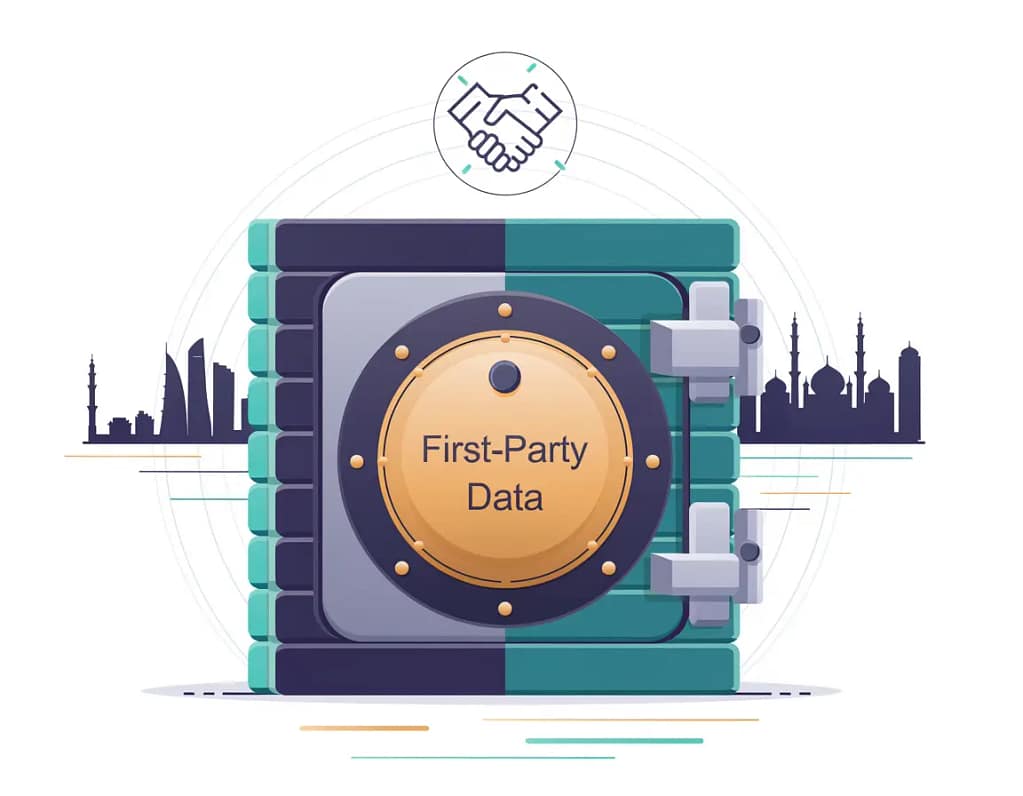
    first-party data strategy B2B advertisers Saudi Arabia Gulf market 2026

    First-Party Data Defined

    First-party data is information your business collects directly from people who interact with you — website visitors, email subscribers, CRM contacts, event attendees, and existing clients. You own it, you collected it with consent, and no platform change or regulatory decision can take it away from you.

    Third-party data, by contrast, is collected by someone else and shared or sold to you. It is this category that is under sustained pressure from both privacy regulation and platform policy changes.

    The Four First-Party Data Assets Every B2B Company Should Build

    For B2B companies in Saudi Arabia, these are the four data assets worth investing in now:

    Your CRM database is your most valuable asset. Every client contact, prospect interaction, and lead captured through your website belongs to you permanently. Keeping this database clean, segmented, and regularly updated is the foundation of everything else.


    Your website conversion tracking via Google Tag Manager and GA4 gives you behavioural data about how prospects interact with your site — which pages they visit, how long they stay, what they click — without depending on third-party cookies. This data belongs to you and is unaffected by platform policy changes.


    Your email list is the only direct channel you own completely. No algorithm controls your access to it. For B2B companies in Saudi Arabia, a well-segmented email list of decision-makers in your target sectors is worth more than any paid audience segment you can buy.


    Your custom audiences in Meta and Google built from your own CRM data consistently outperform cold audience targeting. When you upload your client and prospect list to create lookalike audiences, you are using first-party data to drive paid advertising — a model that is privacy-compliant and platform-resilient.

    How This Connects to SEO, GEO and AI Visibility in 2026

    First-Party Data and Content Strategy Are the Same Investment

    The same activity that builds your first-party data — publishing authoritative content, capturing leads through valuable resources, building an email audience — also builds the topical authority and entity signals that determine your visibility in Google and AI-generated answers.

    A B2B company in Saudi Arabia that publishes a quarterly analysis of digital marketing trends in the Gulf market is simultaneously building its first-party audience, generating backlinks, and creating the kind of original data that AI systems actively cite. These are not separate strategies. They are the same strategy executed consistently.

    Schema Markup Signals Trustworthiness to AI Systems

    Correctly configured schema markup on your website tells AI systems not just what you do, but who you are, where you operate, and what you can be trusted to speak about. For Gulf market B2B advertisers navigating a changing data landscape, this entity-level trustworthiness is what determines whether your content appears in AI-generated answers when your target clients are researching solutions.

    What B2B Advertisers in Saudi Arabia Should Do Now

    Audit Your Current Data Dependency

    Map every campaign you are running and identify which ones depend on third-party cookies or platform-owned audience data. These are your exposures. Any campaign that would stop working tomorrow if Chrome changed its policy again is a campaign that needs a first-party data alternative.

    Implement Server-Side Tracking

    Server-side tracking moves your conversion tracking from the browser — where it is vulnerable to ad blockers, iOS restrictions, and cookie policies — to your server. This gives you more reliable conversion data regardless of what happens at the browser level. It requires technical implementation but is one of the highest-return technical investments available to B2B advertisers in 2026.

    Build Your CRM as a Strategic Asset

    Every lead captured, every client onboarded, every prospect who downloads a resource should enter a structured CRM with proper segmentation. In Saudi Arabia’s B2B market, where relationship-driven sales cycles are long, a well-maintained CRM is the difference between a business with compounding commercial intelligence and one that starts every year from zero.

    Create Content That Earns Direct Relationships

    The most durable first-party data strategy is also the simplest: give people a reason to come to you directly and leave their contact information willingly. Original research, market-specific guides, and practical tools — the kind of content that Saudi B2B decision-makers actually find useful — build audience relationships that no platform policy can disrupt.

    The Bottom Line

    Google kept cookies. But the advertisers who used the cookie debate as a wake-up call to build first-party data capabilities are now structurally stronger than those who treated Google’s reversal as permission to keep doing what they were doing.

    In Saudi Arabia’s fast-growing B2B market, the companies that will win sustained digital visibility in 2026 and beyond are those building owned data assets, publishing authoritative content, and structuring their online presence to be trusted by both Google and the AI tools their clients are increasingly using to find suppliers and partners.

    At Marketing Di Rete, we help B2B companies in Saudi Arabia and the Gulf build exactly this kind of resilient digital presence — combining paid advertising strategy, Technical SEO, and content systems that work regardless of what Google decides next.

    Book a free strategy call to understand where your current data strategy stands and what a Gulf-market-appropriate alternative looks like for your business.

  • Digital Marketing Agency Dammam — B2B Growth Saudi Arabia

    Digital Marketing Agency Dammam — B2B Growth Saudi Arabia

    Digital Marketing Agency Dammam — B2B Growth in Saudi Arabia’s Eastern Province

    Finding the right digital marketing agency in Dammam is a critical decision for any B2B company operating in Saudi Arabia’s Eastern Province. Dammam is the Kingdom’s industrial and energy capital — home to Aramco’s global headquarters, one of the most concentrated clusters of petrochemical, logistics, and manufacturing companies in the entire Gulf region. Yet most businesses here are still relying on referrals and trade relationships while their competitors build digital visibility that compounds month after month.

    Why Dammam Is Saudi Arabia’s Most Underserved B2B Digital Market

    Riyadh gets the attention. Jeddah gets the trade traffic. But Dammam — and the broader Eastern Province — is where Saudi Arabia’s industrial backbone operates. Al Khobar, Dhahran, and Dammam together form a business corridor with a concentration of B2B decision-makers that rivals any city in the Kingdom.

    The digital marketing gap here is significant. Most agencies focus their Saudi Arabia efforts on Riyadh and Jeddah, leaving Eastern Province businesses underserved and underrepresented online. Companies that build their search presence in Dammam now are establishing a competitive advantage that will be difficult to close in 12 to 24 months.

    Vision 2030 is accelerating this. The Eastern Province is a core beneficiary of Saudi Arabia’s economic diversification push — new industrial zones, logistics infrastructure, and technology investment are all driving demand for professional services, including digital marketing.

    What B2B Digital Marketing in Dammam Actually Requires

    The Eastern Province B2B market has specific characteristics that shape what effective digital marketing looks like here.

    Decision-makers are technically sophisticated. Dammam’s business community is heavily concentrated in energy, engineering, petrochemicals, and logistics — sectors where buyers conduct detailed research before engaging a vendor. Content strategy and thought leadership matter more here than in generalist markets.

    The competitive landscape is less crowded. Unlike Riyadh where dozens of agencies compete for the same keywords, Dammam has minimal digital marketing competition. A well-optimised presence built now will be significantly harder to displace than one built after the market matures.

    B2B buying cycles are long. In Dammam’s industrial sectors, procurement decisions involve multiple stakeholders and extended evaluation periods. Digital marketing here is about building sustained visibility and credibility — not generating quick transactional leads. SEO and LinkedIn are the primary channels.

    Arabic and English both matter. Eastern Province companies operate bilingually across their supply chains. A digital marketing strategy that ignores Arabic search behavior leaves significant market share uncaptured.

    The Four Services B2B Companies in Dammam Need Most

    Technical SEO for Dammam B2B Companies

    Before advertising makes sense, your website needs to rank in Saudi Arabian search results for the queries your Dammam prospects are using. Technical SEO for the Eastern Province market means fast load times, correct indexing, bilingual URL structure where relevant, and geographic signals that tell Google your business specifically serves Dammam and the broader Eastern Province.

    A full technical audit identifies exactly where your site is losing visibility — and what needs to happen before paid campaigns can generate a positive return.

    Paid Advertising — Google and Meta Ads for Dammam

    Google Ads in the Eastern Province requires precise geographic and demographic targeting. Broad national campaigns waste budget on audiences outside your service area. For B2B companies in Dammam, effective campaigns are built around specific job titles, industry verticals, and Eastern Province geographic targeting — Al Khobar, Dhahran, Jubail, and Dammam itself.

    Every campaign is measured against lead generation outcomes — not vanity metrics like impressions or reach.

    Web Design for Eastern Province B2B Companies

    A website built for a Western audience will not convert Gulf B2B buyers. Eastern Province decision-makers look for specific credibility signals — clear registration details, sector-specific case studies, professional credentials, and fast mobile performance. Arabic language capability signals genuine market commitment.

    We design and build B2B websites that perform in the Saudi market — fast, credible, and structured to convert technical and professional buyers into qualified leads.

    Social Media Management for B2B Brands in Dammam

    LinkedIn is the primary B2B platform for the Eastern Province business community. Consistent thought leadership content — market insights, technical expertise, service updates — builds the brand recognition that shortens sales cycles in Dammam’s relationship-driven market.

    A structured LinkedIn presence positions your company as a credible, knowledgeable partner before a prospect ever picks up the phone.

    Why Work With a UAE-Registered Agency for Your Dammam Marketing

    Marketing Di Rete is a UAE-registered digital marketing agency operated from Italy, serving B2B companies across Saudi Arabia and the Gulf. Dammam and the Eastern Province are a core part of our Saudi Arabia market focus alongside Riyadh and Jeddah.

    UAE registration means we operate within the same Gulf regulatory framework as our clients, understand the cultural and business environment of the Eastern Province, and bring the operational standards that international B2B companies expect. We are a boutique senior-led agency — the founder is the sole accountable strategist on every engagement. No account managers, no junior staff, no standardised packages.

    What Working With Us Looks Like

    Every Dammam engagement begins with a Digital Presence Audit — a structured review of your current website, search visibility, and competitive landscape in the Eastern Province market. You receive a clear gap analysis and priority list before any budget is committed.

    From there we build a 90-day market growth roadmap tailored to your sector, your target audience in Dammam, and your realistic timeline. Fixed scope, clear deliverables, no surprises. Implementation begins within days.

    Frequently Asked Questions — Digital Marketing in Dammam

    Q: Do I need a local office in Dammam to work with you?

    A: No. We serve B2B clients across Saudi Arabia’s Eastern Province remotely. All strategy, execution, and reporting happens digitally. A physical presence in Dammam is not required to generate leads and build search visibility there.

    Q: How long does it take to see results in the Dammam market?

    A: Paid advertising campaigns can generate visibility and leads within the first 2 to 4 weeks. Organic search visibility through Technical SEO typically builds over 3 to 6 months. We recommend combining both — paid for immediate presence, organic for long-term authority in the Eastern Province.

    Q: Do you serve companies in Al Khobar and Dhahran as well as Dammam?

    A: Yes. We serve B2B companies across the entire Eastern Province — Dammam, Al Khobar, Dhahran, Jubail, and the broader region. Your strategy will be tailored to your specific location and target market within the province.

    Q: What industries do you serve in Dammam?

    A: We focus on B2B companies — professional services, technology, logistics, energy sector suppliers, petrochemical companies, manufacturing firms, and SMEs and startups entering or growing in the Eastern Province market.

    Q: What is the minimum engagement?

    A: We work on project-based engagements starting with a Digital Presence Audit, and ongoing monthly retainers for companies ready to execute. Book a free strategy call to discuss what makes sense for your timeline and budget.

    Ready to Grow Your B2B Business in Dammam?

    The Eastern Province B2B market is moving. Companies building their digital presence in Dammam today are establishing search rankings and brand authority that their competitors will spend years trying to catch up with. The window to build this advantage before the market becomes crowded is open now.

    Book a free 30-minute strategy call. We will tell you honestly whether we are the right fit, what a realistic growth timeline looks like for your specific situation in Dammam, and what needs to happen first.

  • Digital Marketing Agency in Jeddah — B2B Growth in Saudi Arabia

    Digital Marketing Agency in Jeddah — B2B Growth in Saudi Arabia

    Digital Marketing Agency Jeddah — B2B Growth in Saudi Arabia’s Commercial Capital

    Finding the right digital marketing agency in Jeddah is one of the most important decisions a B2B company can make when entering or expanding in Saudi Arabia. Jeddah is the Kingdom’s commercial gateway — a city of over 4 million people, home to some of Saudi Arabia’s most active trading companies, logistics businesses, and professional services firms. Yet most businesses operating here are still competing with outdated digital strategies while Vision 2030 transforms the market around them.

    Why Jeddah Is Saudi Arabia’s Most Competitive B2B Market

    Jeddah is not simply Saudi Arabia’s second city. It is the country’s primary port, its financial services hub outside Riyadh, and the entry point for a significant share of the Kingdom’s import and export activity. For B2B companies — whether you are a logistics provider, a professional services firm, a technology company, or a manufacturer — Jeddah represents a concentration of decision-makers that is unmatched outside the capital.

    The challenge is visibility. With Vision 2030 accelerating economic diversification, new businesses are entering the Jeddah market every month. Companies that build their digital presence now — search rankings, paid advertising infrastructure, and brand authority — will be significantly harder to displace in 12 months than they are today.

    What B2B in Digital Marketing Jeddah Actually Requires

    Digital marketing for B2B companies in Jeddah is not the same as running generic campaigns. The Jeddah market has specific characteristics that any serious agency must understand before spending a single riyal on advertising.

    Search behavior is bilingual. Decision-makers in Jeddah search in both Arabic and English depending on the context. Technical procurement searches often happen in English. Local supplier discovery frequently happens in Arabic. A strategy that ignores either language leaves significant market share on the table.

    The buying cycle is relationship-driven. B2B sales in Jeddah rarely close from a single ad click. Digital marketing here is about building credibility and authority over time — so that when a decision-maker is ready to engage, your brand is already familiar and trusted. This means SEO and content strategy matter as much as paid advertising.

    LinkedIn is the primary B2B platform. While Instagram and Snapchat dominate consumer behavior in Saudi Arabia, LinkedIn is where Jeddah’s B2B decision-makers spend professional time. A social media strategy for B2B companies in Jeddah must be anchored on LinkedIn, not consumer platforms.

    The Four Services B2B Companies in Jeddah Need Most

    Technical SEO for Jeddah B2B Companies

    Before any paid advertising makes sense, your website needs to be technically sound enough to rank in Saudi Arabian search results. This means fast load times, correct indexing, proper URL structure, and — critically — signals that tell Google your business serves the Jeddah and Saudi Arabia market specifically.

    Technical SEO for the Gulf market also includes considerations that do not apply in Europe or North America. Bilingual URL structures, hreflang implementation for Arabic content, and Core Web Vitals optimisation for mobile-first Saudi users are all part of a proper technical foundation.

    Paid Advertising — Google and Meta Ads for Jeddah

    Google Ads in Saudi Arabia requires geographic targeting precision. Broad national campaigns waste budget on audiences outside your service area. For B2B companies in Jeddah, the right approach is tightly targeted campaigns focused on decision-maker job titles, industry verticals, and specific geographic areas within the city and surrounding region.

    Meta advertising — primarily Instagram in the consumer space — can work for B2B brand awareness in Saudi Arabia, but the targeting must be calibrated for professional audiences. Vanity metrics like reach and impressions are irrelevant. Every campaign should be measured against lead generation outcomes.

    Web Design for Gulf Market B2B Companies

    A website built for a European or North American audience will not convert Gulf buyers. The visual language, content structure, and trust signals that work in Western markets often land differently with Saudi B2B decision-makers.

    Effective B2B web design for the Jeddah market prioritises credibility signals — clear registration details, professional credentials, case studies framed around outcomes, and fast mobile performance. Arabic language capability, even if secondary, signals genuine market commitment.

    Social Media Management for B2B Brands in Jeddah

    LinkedIn presence is non-negotiable for B2B companies building authority in Jeddah. Consistent, professionally positioned content — thought leadership, market insights, service updates — builds the kind of brand recognition that shortens sales cycles and increases inbound enquiry quality.

    Instagram can supplement LinkedIn for brand awareness, but the content strategy must be adapted for Saudi cultural context and business norms. Generic global content does not build trust with Jeddah decision-makers.

    Why Work With a UAE-Registered Agency for Your Jeddah Marketing

    Marketing Di Rete is a UAE-registered digital marketing agency operated from Italy, serving B2B companies across Saudi Arabia and the Gulf. Our primary market is Saudi Arabia — Riyadh, Jeddah, Dammam, and KSA broadly.

    Being UAE-registered is not a coincidence. It means we operate within the same regulatory framework as our Gulf clients, understand the cultural and business environment that shapes buying decisions in Jeddah, and bring the operational standards that international B2B companies expect from a senior-led agency.

    We are a boutique agency. The founder is the sole accountable strategist on every engagement. There are no account managers or junior staff between you and the person executing your strategy. Every client in Jeddah receives direct access to senior expertise — not a standardised package delivered by a generalist team.

    What Working With Our Digital Marketing Agency Jeddah Looks Like

    Every Jeddah engagement starts with a Digital Presence Audit — a structured review of your current website, search visibility, and competitive landscape in the Saudi market. You receive a clear gap analysis and priority list before any budget is spent.

    From there, we build a 90-day market growth roadmap tailored to your sector, your target audience in Jeddah, and your realistic timeline. Fixed scope, clear deliverables, no surprises.

    Implementation begins within days. Your first campaign or optimisation deliverable is live before the end of the first month.

    Frequently Asked Questions — Digital Marketing in Jeddah

    Q: Do I need a local office in Jeddah to work with you?

    A: No. We serve B2B clients across Saudi Arabia remotely. All strategy, execution, and reporting happens digitally. A local presence is not required to generate leads and build search visibility in Jeddah.

    Q: How long does it take to see results in the Jeddah market?

    A: Paid advertising campaigns can generate visibility and leads within the first 2 to 4 weeks. Organic search visibility through Technical SEO typically builds over 3 to 6 months. We recommend combining both — paid for immediate presence, organic for long-term authority.

    Q: Do you work with companies that are new to the Saudi market?

    A: Yes. Many of our clients are entering Saudi Arabia for the first time. We help them build the digital foundation — search presence, advertising infrastructure, and brand positioning — before competitors establish themselves.

    Q: What industries do you serve in Jeddah?

    We focus on B2B companies — professional services, technology, logistics, manufacturing, and consultancy firms, as well as SMEs and startups entering or growing in the Saudi market. Our engagements are built around business-to-business growth, not consumer or retail marketing.

    Q: What is the minimum engagement?

    A: We work on project-based engagements starting with a Digital Presence Audit, and ongoing monthly retainers for companies ready to execute. Book a free strategy call to discuss what makes sense for your timeline and budget.

    Ready to Grow Your B2B Business in Jeddah?

    Jeddah’s B2B market is moving fast. The companies building their digital presence today are the ones that will dominate search results and lead generation pipelines in 2026 and beyond. The window to enter before your competitors establish themselves is open — but it will not stay open indefinitely.

    Book a free 30-minute strategy call. We will tell you honestly whether we are the right fit, what a realistic growth timeline looks like for your specific situation in Jeddah, and what needs to happen first.

  • Generative AI for Digital Marketing in Saudi Arabia

    Generative AI for Digital Marketing in Saudi Arabia

    Generative AI for Digital Marketing in Saudi Arabia

    In today’s digital world, every business needs to have a strong online presence to thrive. Whether you’re a small business or a large enterprise, ranking higher in search engine results pages (SERPs) is critical. Higher rankings mean more visibility, which leads to more customers and higher profits.


    However, ranking organically (without spending a fortune on ads) has always been a tough battle. Businesses have had to compete fiercely for the top spots, focusing on keyword optimization, backlink building, and creating high-quality content. While these strategies still play a role, the SEO landscape is changing—and it’s evolving fast with the introduction of Generative AI.

    generative ai for digital marketing

    Generative AI  in marketing is revolutionizing how businesses engage with their audiences. In Italy and the UAE, companies are leveraging this cutting-edge technology to automate content creation, enhance SEO strategies, and personalize customer experiences. In this post, we’ll explore how Generative AI for digital marketing can benefit your business, highlight its challenges, and provide insights into the best tools for integrating AI into your marketing strategy.

    What is Generative AI and How Does it Benefit Digital Marketing?

    What is Generative AI?

    Generative AI in marketing refers to the subset of artificial intelligence that is capable of creating new content, such as text, images, and videos, based on existing data. Unlike traditional AI, which focuses on data analysis, generative AI creates content that is tailored to your specific marketing needs. This can significantly improve efficiency and personalization in digital marketing efforts

    Read about how AI is changing the marketing landscape

    In Italy, the UAE, and many other countries, companies are leveraging this cutting-edge technology to automate content creation, enhance SEO strategies, and personalize customer experiences. In this post, we’ll explore how Generative AI for digital marketing can benefit your business, highlight its challenges, and provide insights into the best tools for integrating AI into your marketing strategy.

    Why SEO Has Evolved: The Emergence of Generative AI

    Generative AI for marketing has completely transformed the SEO game by introducing new capabilities that were previously unimaginable. Traditional SEO relied heavily on manual efforts like keyword research, content creation, and link building. But now, with Gen AI tools, businesses can automate many of these tasks and do them more efficiently.

    How Generative AI For Digital Marketing Works

    1. Content Creation

    AI can automate the generation of high-quality blog posts, social media content, and product descriptions using  AI  tools. This saves valuable time and ensures consistency across all your content.

    2. SEO Optimization

    Generative AI improves your SEO strategy by producing SEO-friendly content at scale. AI tools help optimize content for relevant keywords, topics, and user intent, ensuring your content ranks higher in search engines.

    3. Personalization

    AI can tailor marketing messages, product recommendations, and content to the individual needs of customers in specific regions, such as Italy and the UAE. This helps businesses offer localized experiences and connect better with their audience.

    Here’s why Gen AI is a game changer for SEO:

    1. Automated Content Creation

    Gen AI for marketing allows businesses to automate content creation at scale. Instead of spending hours crafting blog posts, AI can write articles, social media posts, product descriptions, and even ad copy. This means businesses can produce more content that’s optimized for SEO without the long wait.

    2. Enhanced Personalization

    AI tools can analyze user behavior and generate content that’s tailored to specific audiences. This allows businesses to provide more relevant content, improving engagement and conversion rates—something traditional SEO strategies could only dream of achieving at scale.

    3. Smarter Keyword Optimization

    With AI-powered SEO tools, you can quickly identify the best keywords to target based on current trends, search volumes, and user intent. AI can also suggest semantic variations of keywords, ensuring that your content ranks not just for primary keywords but also for related terms that might improve visibility.

    4. Real-Time Data and Adaptation

    One of the most exciting features of AI is its ability to analyze vast amounts of data in real-time. This means businesses can adapt quickly to changes in search trends, user behavior, and algorithm updates. AI tools provide instant insights that would have taken traditional SEO teams weeks to discover.

    The Key Benefits of Generative AI for Digital Marketing

    1. Increased Efficiency in Content Creation

    With Gen AI for marketing, businesses can significantly speed up their content creation process. Instead of spending hours crafting blog posts, social media updates, or product descriptions, AI tools can handle much of the work. This increases productivity, allowing marketers to focus on strategy and creativity.

    2. Enhanced SEO and Personalization

    By using Generative AI in marketing, businesses can optimize their content for search engines more efficiently.

    AI tools like Surfer SEO or WriteSonic help analyze top-ranking content and suggest optimizations for better SEO. Additionally, AI allows for hyper-personalized content that caters to specific customer preferences, improving conversion rates and engagement.

    3. Cost-effective Automation

    Generative AI  for marketing reduces the time and resources spent on manual marketing tasks.

    By automating content generation, email marketing, and lead nurturing, businesses can cut costs while maintaining high-quality output.

    This is particularly beneficial for small to medium-sized businesses looking to scale their digital marketing efforts in Italy and the UAE.

    Now that you know the importance of Gen AI for marketing to your SEO efforts, let’s explore how to start applying it.

    How Businesses Can Start Applying Generative AI in Their SEO Strategy

    So, what does this all mean for your business, and how can you start applying  AI Digital  Marketing Tools to improve your SEO efforts? Here’s a simple guide to help you get started:

    1. Start Using AI-Powered Content Tools

    Tools like Jasper, Copy.ai, and WriteSonic can help you create SEO-optimized blog posts, social media content, and ad copy. These tools are designed to generate content that incorporates keywords, maintains a natural flow, and fits your audience’s needs.

    Actionable Tip: Choose an AI tool, and start by creating a few pieces of content using the tool. Focus on content that aligns with high-value keywords in your industry.

    2. Optimize Your Existing Content with AI

    Once you’ve started generating content, you can use AI tools like Surfer SEO or Frase to audit and optimize your existing pages. These tools help you refine content based on real-time SEO data and suggest improvements that can increase your rankings.

    Actionable Tip: Run one or two of your top-performing pages through these AI-powered audit tools to see where improvements can be made (e.g., keyword density, content structure, etc.).

    3. Leverage AI for Backlink Strategy

    AI Tools can help identify high-quality backlink opportunities by analyzing competitor content and finding relevant sites that might be interested in linking to your content.

    Actionable Tip: Use AI tools to analyze competitors’ backlink profiles and identify where you can guest post or get backlinks from reputable sources.

    4. Monitor SEO Performance in Real-Time

    AI-powered analytics platforms like MarketMuse and SEMrush can track your SEO performance and adjust strategies as needed, offering real-time insights into keyword rankings, traffic, and user engagement.

    Actionable Tip: Use these tools to set up alerts and monitor how well your content is performing across search engines, and adjust your strategy accordingly.

    Ready to revolutionize your marketing with Generative AI?

    Contact us today for a free consultation on how AI can boost your business in Italy and the UAE

    How to Integrate Generative AI in Digital Marketing

    1. Choosing the Right AI Tools for Marketing

    To get started with Generative AI for marketing, selecting the right tools is crucial. Tools like ChatGPT for content generation, WriteSonic for AI-powered copywriting, and Surfer SEO for content optimization are great options to consider. These tools can streamline your digital marketing tasks and allow you to focus on creative strategy.

    2. Incorporating AI into Your Content Strategy

    AI should complement your content strategy, not replace human creativity. Use gen ai tools for digital marketing to automate repetitive tasks while ensuring that your content maintains a personal and authentic touch. Regularly review and refine AI-generated content to keep it aligned with your brand voice.

    3. Monitoring Performance and Optimizing AI-Generated Content

    Once you’ve integrated  ai tools  into your marketing strategy, it’s important to monitor performance. Use analytics tools like Google Analytics and Google Search Console to track the effectiveness of AI-generated content. Adjust and optimize content based on data-driven insights to continuously improve your results.

    Read our blog post at marketing di rete to Find out  free and paid ai tools for digital marketing

    Generative AI vs. Artificial Intelligence: Understanding the Difference

    While Artificial Intelligence (AI) is a broad field referring to systems that mimic human intelligence, Generative AI is a specific subset focused on creating new content—such as text, images, music, or videos—based on data it has learned from.

    • AI, in general, encompasses technologies like machine learning, natural language processing (NLP), robotics, and computer vision to perform tasks typically requiring human intelligence.

    • Generative AI, on the other hand, uses advanced algorithms to produce original content, going beyond analysis and classification.

    In digital marketing, Generative AI creates blog posts, ad copies, social media content, and more, whereas AI in a broader sense could be used for tasks like user experience optimization, automated data analysis, and predictive analytics.

    Discover the latest AI tools for digital marketing trends

    Common Pitfalls to Avoid When Using Generative AI for Marketing

    1. Over-Reliance on AI

    While AI can automate many aspects of digital marketing, it’s important to not completely replace human involvement. AI-generated content should be reviewed, refined, and personalized to ensure it resonates with your audience.

    Generative AI should enhance your team’s creativity, not replace it.

    2. Ignoring Ethical and Privacy Considerations

    AI-generated content must always be original. Ensure your AI tools respect copyright laws and do not generate content that could be flagged for plagiarism.

    Additionally, businesses in Italy and the UAE need to be mindful of local data protection regulations, such as GDPR in Europe and the UAE’s privacy laws, when using AI tools that process customer data.


    Understand GDPR compliance for digital marketing in Italy


    Learn about data privacy laws in the UAE

    3. Neglecting Personalization

    Generative AI in marketing excels in personalizing content at scale. However, failing to incorporate audience segmentation and customer insights into AI-generated content can lead to generic messaging.

    Always use Gen AI for marketing tools to create tailored experiences that speak directly to your target audience’s needs and preferences.

    Generative AI in Marketing terms you need to know

    As AI Tools continue to shape the future of digital marketing, here are some key terms you should know:

    1. AEO (AI-Optimized Content)

    AEO refers to content that is optimized by AI algorithms to match user intent and improve performance in search engines.

    2. GEO (Generative AI for Optimization)

    GEO involves using Generative AI to optimize content for local search, focusing on customizing content and promotions for specific geographic areas.

    3. AI Overview in Marketing

    An overview of how AI tools and machine learning algorithms are used to automate tasks, improve customer experiences, and predict future trends in digital marketing.

    4. Zero-Click Searches

    These are searches that show instant answers in the search engine results without requiring users to click through to a website.

    5. Featured Snippets

    A featured snippet is a special search result that appears at the very top of Google search results, providing a direct answer to a search query.

    6. Rich Snippets

    A rich snippet enhances the search result by providing additional details like ratings, prices, or images next to the regular result.

    7. Predictive Analytics with AI

    Uses AI algorithms to predict future outcomes, such as consumer behavior, helping businesses tailor their campaigns.

    8. Semantic Search

    AI helps search engines understand the intent behind what people are looking for, not just the words they use.

    Conclusion

    By understanding these key AI-driven terms and integrating Generative AI into your digital marketing strategy, your business can optimize SEO, create personalized content, and drive more traffic to your website.

    Ready to get ahead of the competition and harness the power of Generative AI?

    Contact us today to learn how we can help integrate AI tools into your digital marketing strategy, driving efficiency and growth for your business.

    Future Trends in Generative AI and Digital Marketing

    1. AI-Powered Video and Visual Content Creation

    As AI technology continues to advance, the ability to generate video and visual content will become more accessible. Businesses will be able to create personalized video ads, product demonstrations, and even interactive media using generative ai for marketing tools. This trend will significantly reduce production time and costs.

    2. Voice Search Optimization with AI

    With the increasing use of voice search, AI will play a crucial role in optimizing content for voice queries. Marketers in Italy and the UAE will need to adjust their strategies to ensure their content is optimized for voice search, which is becoming a key driver of search traffic.

    3. AI-Powered Hyper-Personalization

    Generative AI for marketing will continue to drive hyper-personalization, allowing businesses to provide highly tailored experiences at scale. AI can analyze customer behavior in real-time and adapt content to meet individual needs, boosting engagement and conversion rates.

    Resources for Learning More About Generative AI in Marketing

    • Online Courses:

      • Coursera: Offers courses on AI, machine learning, and digital marketing.

      • Udemy: Provides training on AI tools and digital marketing strategies.

      • LinkedIn Learning: Learn about AI and marketing from industry experts.

    • AI Communities:

      • OpenAI Community: Join discussions on AI tools and marketing trends.

      • Reddit AI Subreddits: Stay updated on AI developments.

    AI Tools for Digital Marketing: What They Do and How They Help Your Business

    1. Jasper

    • What it Does: Jasper is an AI-powered content generation tool that helps create high-quality blog posts, social media content, and ad copy. It can generate SEO-optimized content quickly by understanding your target keywords and audience needs.

    • How It Helps: By using Jasper, businesses can save time on content creation, ensuring that they produce more content without sacrificing quality. It’s perfect for those who need content at scale.

    2. Copy.ai

    • What it Does: Copy.ai is another AI-powered writing tool that generates various types of marketing copy, including blog posts, social media captions, product descriptions, and more.

    • How It Helps: It speeds up the process of creating engaging, persuasive content by automating copywriting, allowing businesses to focus on other tasks like strategy and design.

    3. WriteSonic

    • What it Does: WriteSonic is an AI-powered tool that can create SEO-optimized content for blog posts, product descriptions, ads, and social media posts. It uses AI to generate creative and high-converting copy.

    • How It Helps: WriteSonic helps businesses generate high-quality, SEO-optimized content quickly, which is essential for digital marketing campaigns and maintaining a consistent content schedule.

    4. Surfer SEO

    • What it Does: Surfer SEO is a powerful AI tool that helps businesses optimize their website for search engines by analyzing top-ranking content and suggesting improvements. It looks at keyword density, structure, and other factors to help you rank higher in search results.

    • How It Helps: Surfer SEO takes the guesswork out of SEO optimization by giving businesses data-driven recommendations that can improve their rankings on search engines like Google.

    5. Frase

    • What it Does: Frase is an AI-powered content research and writing tool that analyzes top-performing content for any given topic and creates content briefs or full-length articles based on the research.

    • How It Helps: It helps businesses produce SEO-optimized content quickly by leveraging AI to conduct in-depth content research, saving time and ensuring that the content ranks well in search results.

    6. MarketMuse

    • What it Does: MarketMuse is an AI-driven content optimization platform that helps businesses create content that ranks well on search engines. It analyzes competitors’ content and identifies content gaps, suggesting topics and keywords to improve your content.

    • How It Helps: MarketMuse helps businesses improve their content strategy by creating high-quality content that is better aligned with search intent, leading to higher visibility and engagement.

    7. ChatGPT (OpenAI)

    • What it Does: ChatGPT is an AI conversational model that can generate human-like responses to any query. It is used to create content, provide customer support, and engage with users via chatbots or other conversational interfaces.

    • How It Helps: Businesses can use ChatGPT for customer interaction, generating responses, automating FAQs, and creating personalized communication with users, thus improving engagement.

    8. SEMrush

    • What it Does: SEMrush is an all-in-one marketing platform that offers tools for SEO, keyword research, and competitor analysis. It allows businesses to track their rankings, identify new opportunities, and audit their websites for SEO improvements.

    • How It Helps: SEMrush helps businesses stay on top of their SEO performance by providing real-time data on their website’s ranking, competitor strategies, and keyword performance, allowing them to stay ahead in the SEO game.

    9. Pictory

    • What it Does: Pictory is an AI-powered video creation tool that automatically converts long-form content, like blog posts or articles, into short videos for social media or marketing campaigns.

    • How It Helps: Pictory allows businesses to repurpose written content into engaging video content, which is great for driving traffic on platforms like YouTube, Instagram, and TikTok.

    10. Lumen5

    • What it Does: Lumen5 is an AI-powered video creation platform that converts text-based content into video content. It uses AI to create visually appealing videos from articles or blog posts, making it easier for businesses to share content on video platforms.

    • How It Helps: It helps businesses create video content at scale, which is essential for driving higher engagement on social media and reaching a wider audience through video marketing.

    11. Tidio

    • What it Does: Tidio is an AI-powered chatbot and live chat solution for websites. It allows businesses to provide instant customer support through automated conversations and live chat.

    • How It Helps: Tidio can automate customer support, reduce response time, and engage customers 24/7, helping businesses enhance their customer experience and increase conversions.

    12. Canva (AI Features)

    • What it Does: Canva is a popular design tool that now includes AI-powered design features to help businesses create graphics, social media posts, and presentations with ease.

    • How It Helps: Canva is perfect for businesses that need high-quality visuals without a design team. It provides AI-powered templates that help create content quickly and easily, even for beginners.

    These AI-powered tools are transforming digital marketing by helping businesses create content, improve SEO, and enhance personalization at scale. From generating blog posts and videos to optimizing websites for higher rankings and personalizing customer interactions, these tools are essential for businesses looking to stay competitive in the digital landscape.

    Each tool offers unique features, but when used together, they can help businesses streamline their marketing workflows, boost productivity, and improve customer engagement.

    Conclusion

    As businesses in Italy and the UAE increasingly adopt Generative AI for marketing, the potential to create more efficient, personalized, and scalable marketing strategies grows. By integrating Generative AI in digital marketing, companies can stay competitive and reach their audience in more meaningful ways.

    Ready to implement gen ai for digital marketing in your business?

    Contact us today to learn how we can help you integrate AI tools into your digital marketing strategy.