
First-Party Data Strategy for B2B Companies in Saudi Arabia — What Still Matters in 2026
March 28, 2026
In early 2024, the digital marketing world braced for Google’s planned elimination of third-party cookies from Chrome. Then, in mid-2024, Google reversed course — cookies stayed. Many advertisers exhaled and moved on. That was a mistake.
The underlying shift that drove the cookie debate did not go away. User privacy expectations are higher than ever, iOS tracking restrictions are permanent, EU and Gulf data regulations are tightening, and B2B buyers in Saudi Arabia and the UAE are increasingly privacy-aware. If your advertising strategy still depends entirely on third-party tracking, you are building on a foundation that is narrowing every year.
This post explains what first-party data strategy means for B2B companies operating in Saudi Arabia and the Gulf in 2026, and what you should be doing now regardless of what Google does next.
What Actually Happened With Cookies
Google Kept Cookies — But the Problem Did Not Go Away
Google’s decision to retain third-party cookies in Chrome was not a reversal of the privacy trend — it was an acknowledgement that the industry was not ready for an abrupt transition. The Privacy Sandbox tools Google developed as alternatives remain available and are still being refined.
Meanwhile, Apple’s App Tracking Transparency framework continues to limit cross-app tracking on iOS. Firefox and Safari block third-party cookies by default. And regulators in the EU, UK, and increasingly in Gulf markets are strengthening data protection frameworks.
Third-party cookies still work in Chrome today. But their long-term reliability as a targeting foundation is structurally compromised — and B2B advertisers who have not built alternative data capabilities are exposed.
What This Means for B2B Advertisers in Saudi Arabia
Saudi Arabia enacted its Personal Data Protection Law (PDPL) which sets clear requirements around how businesses collect, store, and use personal data. The UAE has its own Federal Data Protection Law. These regulations are not yet enforced as aggressively as GDPR in Europe — but the direction is clear and the trajectory is toward stronger enforcement.
For B2B companies running paid advertising in Saudi Arabia and the Gulf, this regulatory environment makes first-party data strategy not just a best practice but an increasingly necessary foundation for sustainable campaign performance.
What First-Party Data Strategy Means in Practice
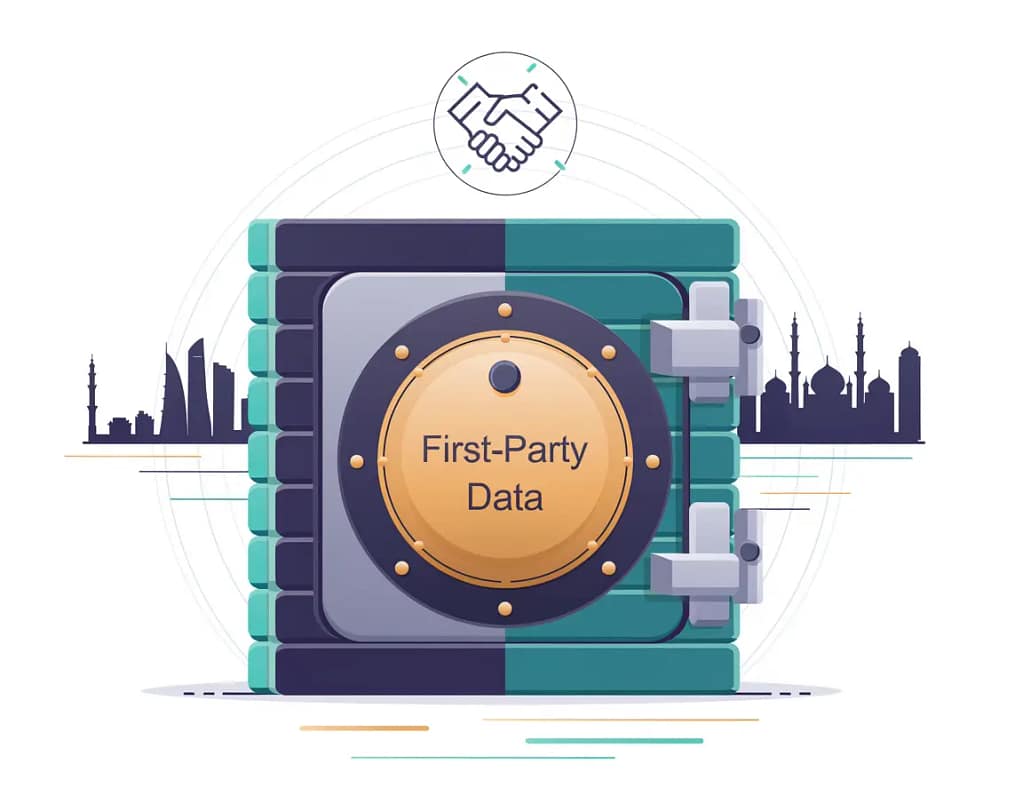
First-Party Data Defined
First-party data is information your business collects directly from people who interact with you — website visitors, email subscribers, CRM contacts, event attendees, and existing clients. You own it, you collected it with consent, and no platform change or regulatory decision can take it away from you.
Third-party data, by contrast, is collected by someone else and shared or sold to you. It is this category that is under sustained pressure from both privacy regulation and platform policy changes.
The Four First-Party Data Assets Every B2B Company Should Build
For B2B companies in Saudi Arabia, these are the four data assets worth investing in now:
Your CRM database is your most valuable asset. Every client contact, prospect interaction, and lead captured through your website belongs to you permanently. Keeping this database clean, segmented, and regularly updated is the foundation of everything else.
Your website conversion tracking via Google Tag Manager and GA4 gives you behavioural data about how prospects interact with your site — which pages they visit, how long they stay, what they click — without depending on third-party cookies. This data belongs to you and is unaffected by platform policy changes.
Your email list is the only direct channel you own completely. No algorithm controls your access to it. For B2B companies in Saudi Arabia, a well-segmented email list of decision-makers in your target sectors is worth more than any paid audience segment you can buy.
Your custom audiences in Meta and Google built from your own CRM data consistently outperform cold audience targeting. When you upload your client and prospect list to create lookalike audiences, you are using first-party data to drive paid advertising — a model that is privacy-compliant and platform-resilient.
How This Connects to SEO, GEO and AI Visibility in 2026
First-Party Data and Content Strategy Are the Same Investment
The same activity that builds your first-party data — publishing authoritative content, capturing leads through valuable resources, building an email audience — also builds the topical authority and entity signals that determine your visibility in Google and AI-generated answers.
A B2B company in Saudi Arabia that publishes a quarterly analysis of digital marketing trends in the Gulf market is simultaneously building its first-party audience, generating backlinks, and creating the kind of original data that AI systems actively cite. These are not separate strategies. They are the same strategy executed consistently.
Schema Markup Signals Trustworthiness to AI Systems
Correctly configured schema markup on your website tells AI systems not just what you do, but who you are, where you operate, and what you can be trusted to speak about. For Gulf market B2B advertisers navigating a changing data landscape, this entity-level trustworthiness is what determines whether your content appears in AI-generated answers when your target clients are researching solutions.
What B2B Advertisers in Saudi Arabia Should Do Now
Audit Your Current Data Dependency
Map every campaign you are running and identify which ones depend on third-party cookies or platform-owned audience data. These are your exposures. Any campaign that would stop working tomorrow if Chrome changed its policy again is a campaign that needs a first-party data alternative.
Implement Server-Side Tracking
Server-side tracking moves your conversion tracking from the browser — where it is vulnerable to ad blockers, iOS restrictions, and cookie policies — to your server. This gives you more reliable conversion data regardless of what happens at the browser level. It requires technical implementation but is one of the highest-return technical investments available to B2B advertisers in 2026.
Build Your CRM as a Strategic Asset
Every lead captured, every client onboarded, every prospect who downloads a resource should enter a structured CRM with proper segmentation. In Saudi Arabia’s B2B market, where relationship-driven sales cycles are long, a well-maintained CRM is the difference between a business with compounding commercial intelligence and one that starts every year from zero.
Create Content That Earns Direct Relationships
The most durable first-party data strategy is also the simplest: give people a reason to come to you directly and leave their contact information willingly. Original research, market-specific guides, and practical tools — the kind of content that Saudi B2B decision-makers actually find useful — build audience relationships that no platform policy can disrupt.
The Bottom Line
Google kept cookies. But the advertisers who used the cookie debate as a wake-up call to build first-party data capabilities are now structurally stronger than those who treated Google’s reversal as permission to keep doing what they were doing.
In Saudi Arabia’s fast-growing B2B market, the companies that will win sustained digital visibility in 2026 and beyond are those building owned data assets, publishing authoritative content, and structuring their online presence to be trusted by both Google and the AI tools their clients are increasingly using to find suppliers and partners.
At Marketing Di Rete, we help B2B companies in Saudi Arabia and the Gulf build exactly this kind of resilient digital presence — combining paid advertising strategy, Technical SEO, and content systems that work regardless of what Google decides next.
Book a free strategy call to understand where your current data strategy stands and what a Gulf-market-appropriate alternative looks like for your business.